




If a better snack is harder to reach, many animals give up and take the easy option. Wild squirrels are more willing to work for it.
In field experiments, grey squirrels continued to choose their preferred food even when it required a longer, more difficult climb. Lower-ranking squirrels were more likely to switch to the easier option as the climb became harder, likely to avoid losing the reward to a dominant rival. The presence of other squirrels also changed behavior: when competitors were nearby, squirrels more often went for the preferred food first. The findings were published in Animal Behaviour.
“This study helps us understand how animals decide how much time and effort to invest,” said senior author Lisa Leaver in a press release. “It shows there isn’t always an ‘optimal’ decision, and — just as with humans — an animal’s social status affects the costs and benefits of particular choices.”
Read More: City Squirrels Might Be Getting Bolder — Or Maybe You’re the One Who’s Changed
How Squirrels Weigh Effort vs. Reward in the Wild
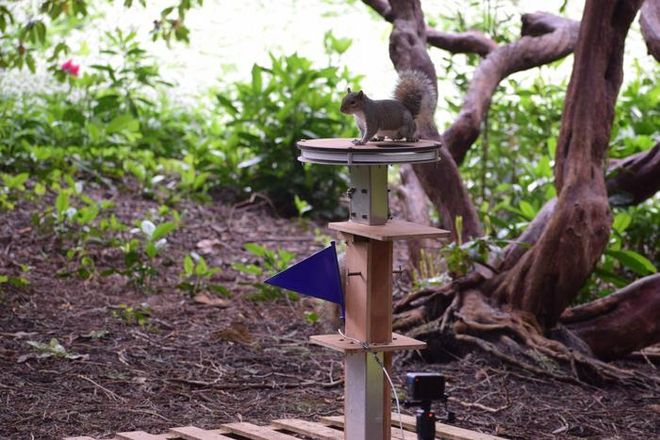
squirrel on the easier feeder
(Image Credit: Yavanna Burnham)
To examine how animals balance effort and reward outside the lab, researchers set up a controlled choice for wild grey squirrels.
Squirrels could climb an easy wooden pole to reach a less-preferred food (pumpkin seeds), or tackle a taller, slippery PVC pole for a favorite (almonds). The harder climb ranged from about 30 inches to just over 2 feet (a meter) in height, increasing the time and effort required to reach the reward.
Across more than 4,000 recorded choices from 11 squirrels, the animals consistently favored almonds. Even as the climb grew trickier, their preference declined only slightly — a pattern known as shallow discounting.
That differs from many lab-based experiments, where animals often abandon better rewards after even small increases in effort or delay.
Social Status and Competition Shaped Choices
Squirrels lower in the pecking order were quicker to opt for the easier option as the climb got harder, likely because taking longer increased the chance of losing the reward to a more dominant rival. The more effort it took to reach the food, the greater the risk of being interrupted.
Dominant squirrels, by contrast, showed little change in their choices. They continued to seek the preferred reward even at greater heights and may have used the higher perch to keep an eye on nearby competitors.
The presence of other squirrels also shifted behavior. When competitors were nearby, squirrels were more likely to go for the preferred food first, even when it required more effort. Researchers say this may reflect a race to secure the better option before another animal could take it.
Squirrels also responded to what had just happened. If they failed to get a reward on a previous attempt — for example, after being pushed aside — they were less likely to repeat that choice.
Effort Adds Up Over Time
Squirrels that had already made many climbs were more likely to switch to the easier option, suggesting that accumulated effort, not just hunger, influenced their decisions. Each additional 4 inches of height also slowed climbing speed, adding to the physical cost over time.
Unlike many lab experiments, the squirrels weren’t locked into a single choice. Both options remained available, allowing them to adjust their strategy from one decision to the next, a setup that more closely reflects real-world foraging.
That flexibility may help explain why the animals didn’t show the steep drop-offs in preference often seen in controlled studies.
In the wild, decisions about effort and reward aren’t fixed. They depend on context — who else is around, how much energy an animal has already spent, and how likely it is to keep what it earns.
Read More: Mpox Outbreak in Wild Monkeys Likely Traced to a Rope Squirrel They Consumed
Article Sources
Our writers at Discovermagazine.com use peer-reviewed studies and high-quality sources for our articles, and our editors review for scientific accuracy and editorial standards. Review the sources used below for this article:
Source: Read Full Article