










SpaceX Starlink satellite suffers mysterious ‘anomaly’ in orbit
Elon Musk’s space Internet company said this satellite, which appears to have blown to pieces, did not appear to pose a risk to the ISS or the upcoming NASA moon mission

Photoillustration by Cheng Xin/Getty Images
One of Elon Musk’s Starlink Internet satellites suffered an “anomaly” on Sunday while in orbit around Earth, the company said in a social media post. The incident appears to have created some debris, with fragments likely to fall to Earth over the next few weeks, according to LeoLabs, a company that monitors satellites in low-Earth orbit.
The satellite lost communication at about 560 kilometers above Earth, Starlink said. While the statement from Starlink, which is a subsidiary of Musk’s rocket company SpaceX, merely noted that investigations are ongoing, LeoLabs said its radar observations of the event indicated an “internal energetic source” as the likely cause rather than a collision. SpaceX and LeoLabs did not immediately respond to a request for comment.
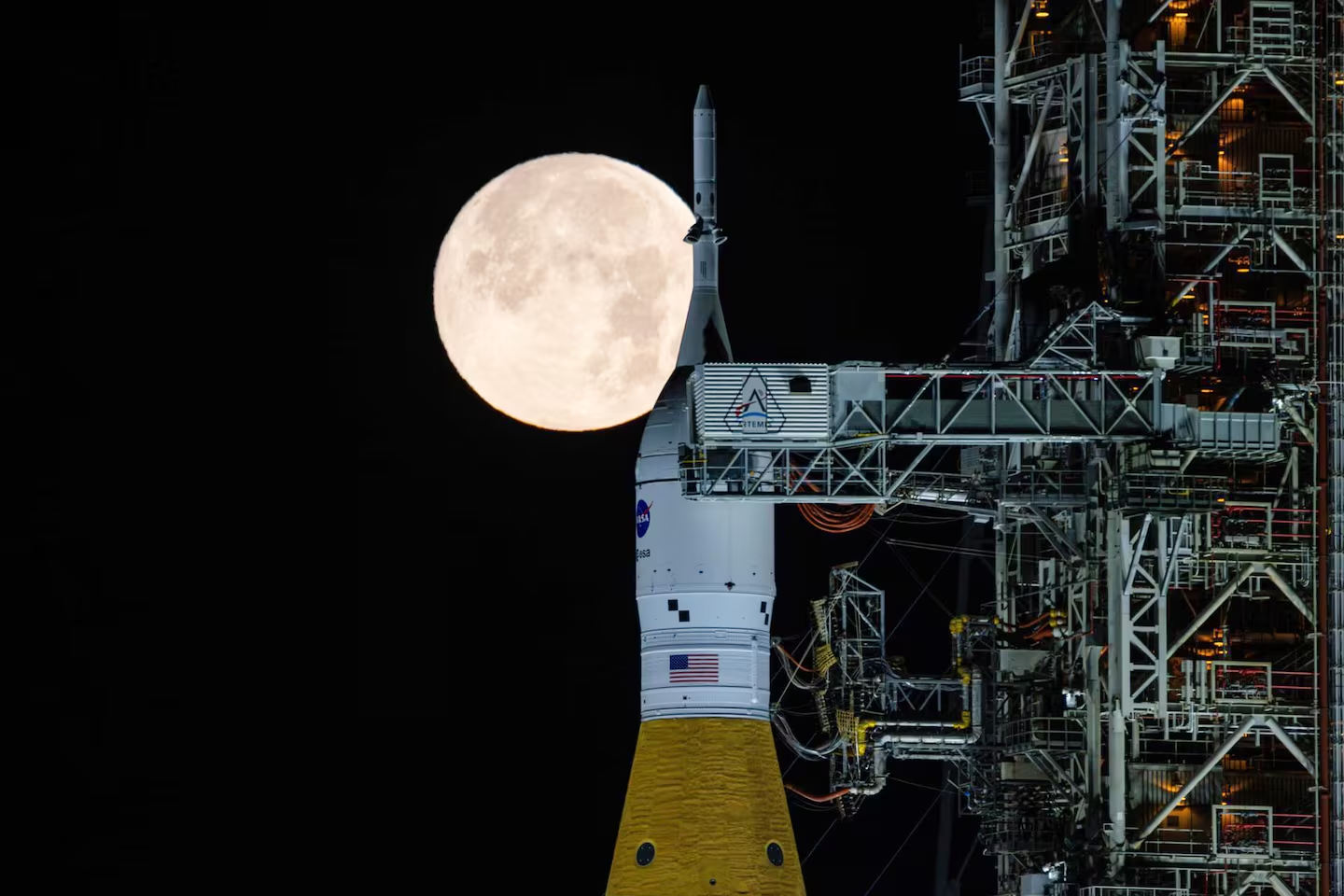
The incident underscores the potential hazards of the increasingly large numbers of satellites and other spacecraft in low-Earth orbit—some 10,000 Starlinks are currently in orbit and counting. Starlink’s statement said that “the event poses no new risk” to the International Space Station or to the upcoming launch of NASA’s Artemis II mission, targeted for April 1.
On supporting science journalism
If you’re enjoying this article, consider supporting our award-winning journalism by subscribing. By purchasing a subscription you are helping to ensure the future of impactful stories about the discoveries and ideas shaping our world today.
Jonathan McDowell, an astrophysicist who closely tracks space activity, is more skeptical, however. “I don’t see how the risks can be nil,” he says. “They are low because all the debris is expected to reenter quickly. But I’d like to hear more about why they assess the risk to be zero.” And if the fragmentation event arose from a design flaw, McDowell adds, that could affect hundreds of Starlinks, “and then the risks go up, a lot.”
“The hope is that SpaceX will identify the root cause and proactively retire any particular subset of satellites that are found to be at risk,” he says.
Editor’s Note (3/31/26): This is a developing story and may be updated.
It’s Time to Stand Up for Science
If you enjoyed this article, I’d like to ask for your support. Scientific American has served as an advocate for science and industry for 180 years, and right now may be the most critical moment in that two-century history.
I’ve been a Scientific American subscriber since I was 12 years old, and it helped shape the way I look at the world. SciAm always educates and delights me, and inspires a sense of awe for our vast, beautiful universe. I hope it does that for you, too.
If you subscribe to Scientific American, you help ensure that our coverage is centered on meaningful research and discovery; that we have the resources to report on the decisions that threaten labs across the U.S.; and that we support both budding and working scientists at a time when the value of science itself too often goes unrecognized.
In return, you get essential news, captivating podcasts, brilliant infographics, can’t-miss newsletters, must-watch videos, challenging games, and the science world’s best writing and reporting. You can even gift someone a subscription.
There has never been a more important time for us to stand up and show why science matters. I hope you’ll support us in that mission.
Source: Read Full Article