









You’ve probably heard the phrase “use it or lose it” used in reference to physical and mental skills. The term “digital dementia” is often trotted out to describe how our dependence on technology has impacted our ability to navigate without GPS or find information for ourselves.
So what happens when you automate as much of your home life as possible?
Some experts warn of digital dementia
Right now, there is no solid evidence to suggest that relying on modern technology directly leads to dementia. But the idea that increased usage of modern devices—particularly screens—leads to shorter attention spans, greater anxiety, even more depression, is well-documented in scientific literature.
The real concern relates to how technology changes the way we interact with our environment. By using our brains less, we could leave ourselves open to declining cognitive function. Studies like Your Brain on ChatGPT link LLM usage with weaker neural connectivity patterns, further fueling concern. Getting ChatGPT to think for you isn’t taxing your gray matter in the same way as doing the work yourself.
In the smart home, common shortcuts include the use of voice assistants, automated appliances like robot vacuum cleaners, and even basic automations that turn lights on for you or remind you that you’ve left a load of laundry in the washing machine. Speculation about the impact of this technology on cognitive decline has made headlines recently.

The so-called risk here isn’t that you’ll forget how to turn a light on, but rather that by changing the way you interact with your environment, you engage your brain less on a daily basis. You’re reshaping your cognitive habits over time, something that isn’t necessarily true in a “dumb” home that’s full of analog devices.
For many smart homeowners, a fully automated home is the goal (though many of us are aware we’ll never achieve it). That’s a big shift away from how we were interacting with our homes five or ten years ago.
Evidence is spotty, to say the least
Though there are undoubtedly some negative side effects that come from endlessly scrolling feeds and short-form video, the same cannot be said for technology as a whole. A study published in Nature and reported by the BBC’s Science Focus magazine looked at 57 studies that comprised over 410,000 middle-aged or older adults to examine the effects of technology on cognitive function.
When controlling for variables like education level, socioeconomic status, employment, general health, age, and more, the study instead noted a positive trend. Use of technology was linked to better brain health, with none of the studies suggesting an increased risk of cognitive decline was associated with technology use.
This conclusion applies more broadly to the use of technology rather than smart home interactions specifically. That could be browsing the internet on a computer, sending messages to friends on a smartphone, or learning how to do something new with the aid of technology.

The study focuses largely on those who are older, who didn’t grow up with technology. Learning is a great workout for your brain, whether that’s a new language or technology, which could explain the observations. This is true whether you’re learning how to use a new piece of software, how to solve a problem, or build your own smart home.
The study’s author, Prof Michael Scullin, told Science Focus: “Take a good look at your digital life. Find the things that are helpful, stimulating, interesting, and connecting – try to do more of those and avoid the things that you think aren’t net positive.”
My smart home helps develop my problem-solving skills
As a Home Assistant user, I can safely say that for all of the dumbing-down I’ve done to my daily routine of turning on lights and shouting at Siri, I’ve also created a lot more work for myself. I constantly find myself tweaking my smart home, it straddles the line between hobby and compulsion.
There’s always something new to work on, an automation that could somehow be improved, or solutions to discover in order to get devices to do what you want. Problems appear without warning, automations require debugging, and logs reveal the real reason things aren’t as they seem.
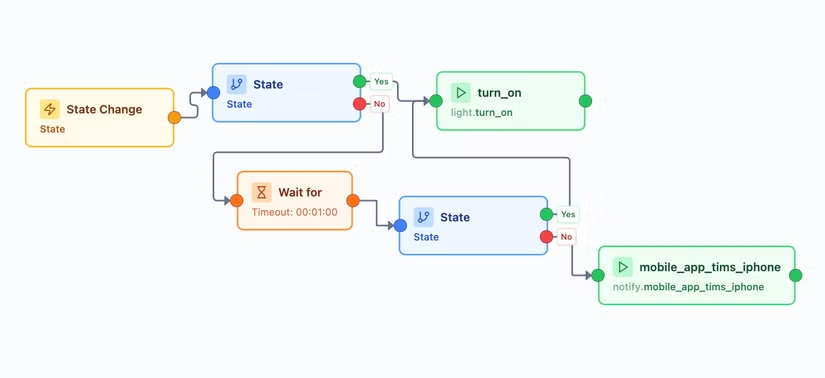
I’m also constantly learning new tricks. The platform itself is expansive, with community integrations that vastly expand what is possible. Overcoming problems like why my garage door opener wasn’t working properly or how to add my new HVAC controller to Home Assistant taught me so much. I’ve also learned from my mistakes and designed an automation that can protect my belongings.
I don’t want to put anyone off going the Home Assistant route. It’s true that there are some things you should know before you jump in, and that ultimately the smart home platform is only as complicated as you want it to be. I say all of this with a wry smile on my face. I’m fully aware that I often pick hard mode and enjoy the challenge it brings.
For as long as there are Home Assistant problems to solve and discoveries to be made, I’m not going to worry too much about my brain turning to soup.
I no longer run a lap of the house at night, turning lights and appliances off for bedtime (I have a scene for that), but I am often lying in bed thinking about new ways to leverage the monster I have built. That’s got to count for something.
Source: Read Full Article