









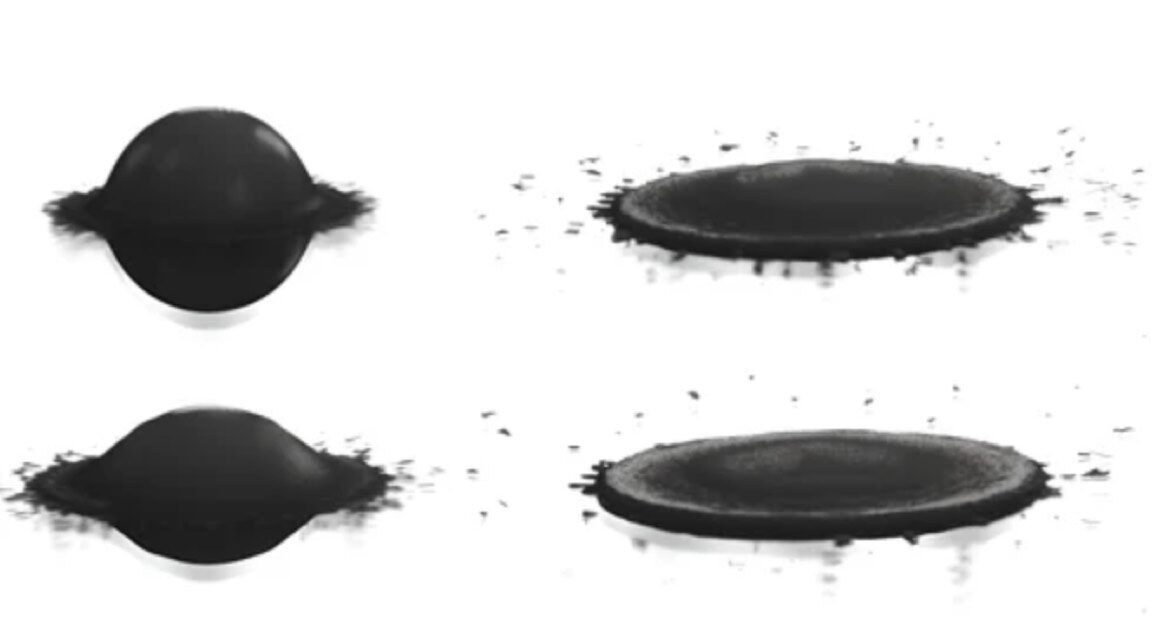
Mixing corn starch and water in appropriate amounts produces a slurry that is liquid when stirred slowly but hardens when you punch it—a substance colorfully dubbed “oobleck.” (The name derives from a 1949 Dr. Seuss children’s book, Bartholomew and the Oobleck.) High-speed imaging and force measurements have revealed another surprising property of oobleck drops hitting a flat surface, according to a new paper published in the journal Physical Review Letters.
As previously reported, in an ideal fluid, viscosity largely depends on temperature and pressure: Water will continue to flow regardless of other forces acting on it, such as stirring or mixing. In a non-Newtonian fluid, the viscosity changes in response to an applied strain or shearing force, thereby straddling the boundary between liquid and solid behavior. Stirring a cup of water produces a shearing force, and the water shears to move out of the way. The viscosity remains unchanged. But for non-Newtonian fluids like oobleck, the viscosity changes when a shearing force is applied.
Ketchup, for instance, is a shear-thickening non-Newtonian fluid, which is one reason smacking the bottom of the bottle doesn’t make the ketchup come out any faster; the application of force increases the viscosity. Yogurt, gravy, mud, pudding, and thickened pie fillings are other examples. And so is oobleck.
Source: Read Full Article