






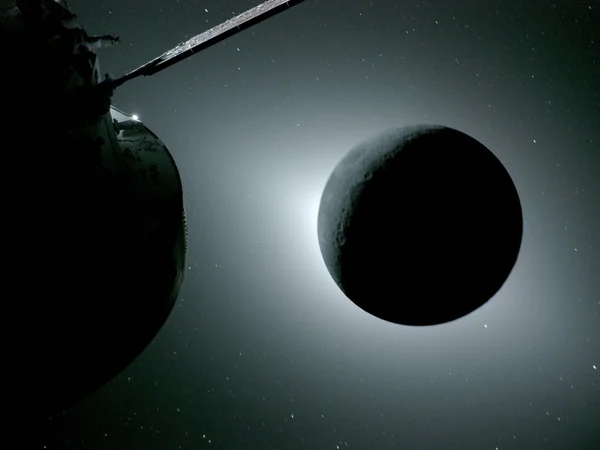



The crew of NASA’s historic Artemis II mission memorialized the late wife of one of its astronauts by proposing to name a crater on the moon after her, an emotional moment captured on NASA’s livestream.
Subscribe to read this story ad-free
Get unlimited access to ad-free articles and exclusive content.

Canadian astronaut Jeremy Hansen radioed to mission control on Monday that the crew wanted to “honor their mission by naming two craters on the moon.”
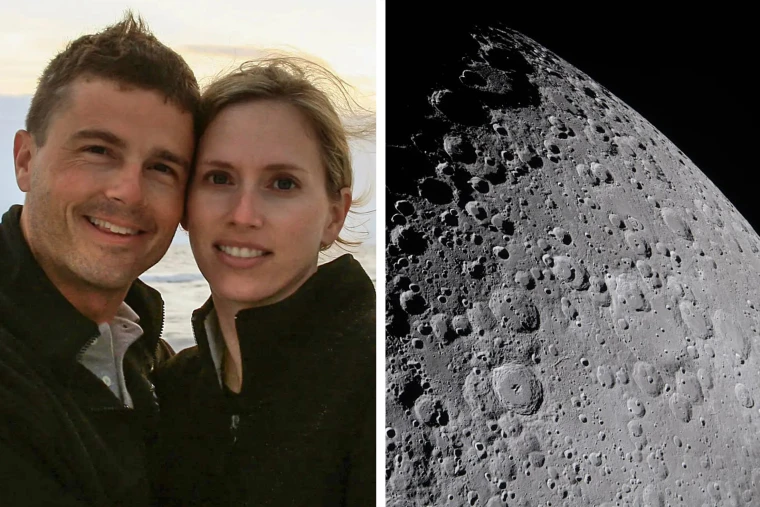
One of the craters was dedicated to the wife of Artemis II commander Reid Wiseman, Carroll Wiseman, who died of cancer in 2020 at 46.
“We lost a loved one, her name was Carroll, the spouse of Reid, the mother of Katey and Ellie,” Hansen said.
He described the crater as “a bright spot on the moon.”
“We would like to call it Carroll,” Hansen said.
After Hansen read the emotional tribute, the group wrapped their arms around each other as they floated in zero gravity. Wiseman and NASA astronaut Christina Koch could be seen wiping tears from their eyes.
Carroll Wiseman “dedicated her life to helping others as a newborn intensive care unit registered nurse,” NASA wrote.
“Despite a long list of professional accolades, Reid considers his time as an only parent his greatest challenge and the most rewarding phase of his life,” Wiseman’s NASA biography reads.
Wiseman was named commander of the Artemis II mission in 2023. Several months before liftoff, Wiseman told NBC’s “TODAY” show that he had felt some trepidation about the time away from his family that the mission demanded.
“I’m a single father of two daughters,” he said. “It’d be a lot easier just to sit on my couch and watch football for the weekend, but at the same time, there’s four humans that were put in a position to be able to go explore and do something that is very unique and rare in this civilization.”
The Artemis II crew also proposed a name for a second crater: “Integrity,” after the name they gave Orion spacecraft.
After the mission, the name proposals will be formally submitted to the International Astronomical Union, which dictates the naming of celestial bodies and the features on their surfaces.
The four Artemis II crew members completed the mission’s lunar flyby on Monday, traveling farther from Earth than any humans had before them. At the most distant point in the mission’s path, the astronauts were approximately 252,752 miles away. They broke the record set by the Apollo 13 crew in 1970.
“As we surpass the furthest distance humans have ever traveled from planet Earth, we do so in honoring the extraordinary efforts and feats of our predecessors in human space exploration,” Hansen radioed to Mission Control when the milestone was confirmed.
“We will continue our journey even further into space before Mother Earth succeeds in pulling us back to everything that we hold dear,” he said. “But most importantly, we choose this moment to challenge this generation — and the next — to make sure this record is not long-lived.”
Wiseman, Koch, Glover and Hansen have beggun their journey home They officially exited the lunar sphere of influence — where the pull of the moon’s gravity is stronger than Earth’s — on Tuesday at 1:25 p.m., when their capsule was roughly 41,000 miles away from the moon, NASA said.
After 10 days in space, the crew is set to return to Earth on Friday, splashing down off the coast of San Diego.
Source: Read Full Article