




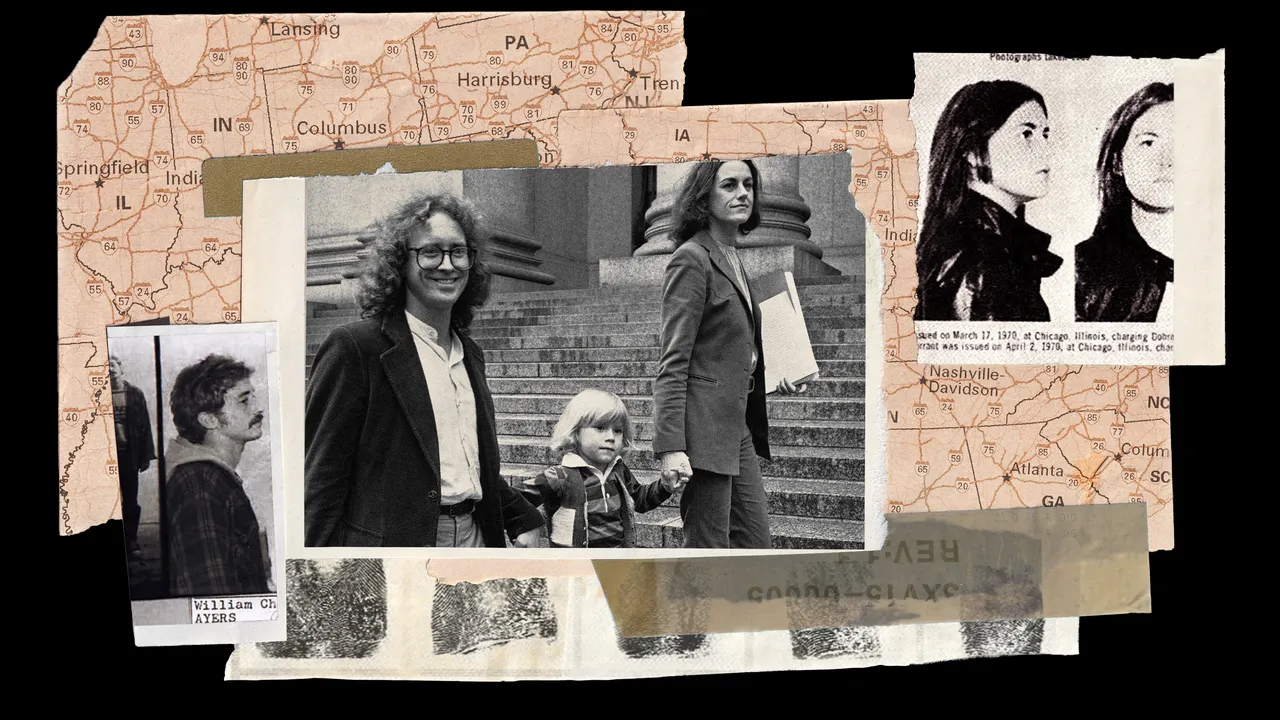
I was born underground and spent my early years on the run. By 1980, though, my parents had finally decided to turn themselves in. A plea deal awaited us in Chicago, but, for the deal to work, we had to make it to the courthouse in person. If we were caught along the way, my mom would spend decades in prison. It was a tense drive that night; my dad says that he kept our station wagon well below the speed limit.
The next morning, we pulled into a rest-stop Burger King. While my mom stayed in the car to nurse the baby, my father and I went inside, and a nice elderly couple started talking to me in line, just making conversation. “Hey, sweetheart,” the man said, smiling down at me. I had shoulder-length blond hair at the time, and people always assumed I was a girl. “You all on vacation?”
I knew I wasn’t supposed to talk to strangers, but my dad was busy ordering our food, and I felt like I had to say something. My response has, in the years since, become a running joke in my family.
“We’re going to Chicago,” I told them, “so my mom can turn herself in to the F.B.I.”
My dad turned, surprised, trying to catch up. “Oh. Yeah, I don’t know,” he said, trying to force a laugh. “Maybe something he saw on TV? Hey, Z, you need to use the bathroom before we go? Say bye.”
I waved. And, before we got our food, he picked me up and ran for our car. As he peeled back out onto the highway, he told my mom that he thought somebody had recognized him. He was trying to protect me, I think. My dad knew that I was desperate not to disappoint my mother—that I wouldn’t want to admit I had broken the underground’s strict codes of secrecy. I looked up to her. I admired her. I wanted to be like her.
Of course, as I got older, that got more complicated. My parents’ brand of violent resistance, I now know, had tragic consequences for our family, and deadly costs for the people around us. Three of my parents’ closest friends were killed in an accidental dynamite explosion as they planned an attack on a U.S. Army base. Others spent decades behind bars, leaving their children without mothers or fathers. And years later, when the group splintered into increasingly militant factions, some took part in a disastrous bank robbery that killed an innocent guard and two police officers—three men who were just doing their jobs that day, and who left behind their own kids, their own families.
Of course, I didn’t know any of this at the time. I just remember watching my mom’s face in the rearview mirror, wondering what she was thinking—whether she was also scared—as she scanned the maps in our faded Rand McNally road atlas. In our family, my father was usually the one driving, but there was never any doubt who was setting our direction.
“Get off at the next exit,” she ordered him. “We’ll switch to local roads.”
My mother wasn’t always a revolutionary. She grew up a middle-class white girl in Whitefish Bay, Wisconsin. Her dad was the credit manager for a local chain of appliance stores, a second-generation Jewish immigrant, and a lifelong Republican. My mom seemed, at first, eager to please; she was a straight-A student, and, at seventeen, became the first person in the family to go to college, at the University of Chicago, where she soon went on to law school as one of only a handful of coeds in her first-year class.
Source: Read Full Article