







The Jovian system has four large moons, including the largest moon in the Solar System, Ganymede, whereas the Saturnian system is dominated by one giant moon. New simulations suggest Jupiter’s powerful magnetism carved a gap in its early disk, helping capture and preserve major moons like Io and Ganymede, while Saturn’s weaker field left its system sparsely populated.
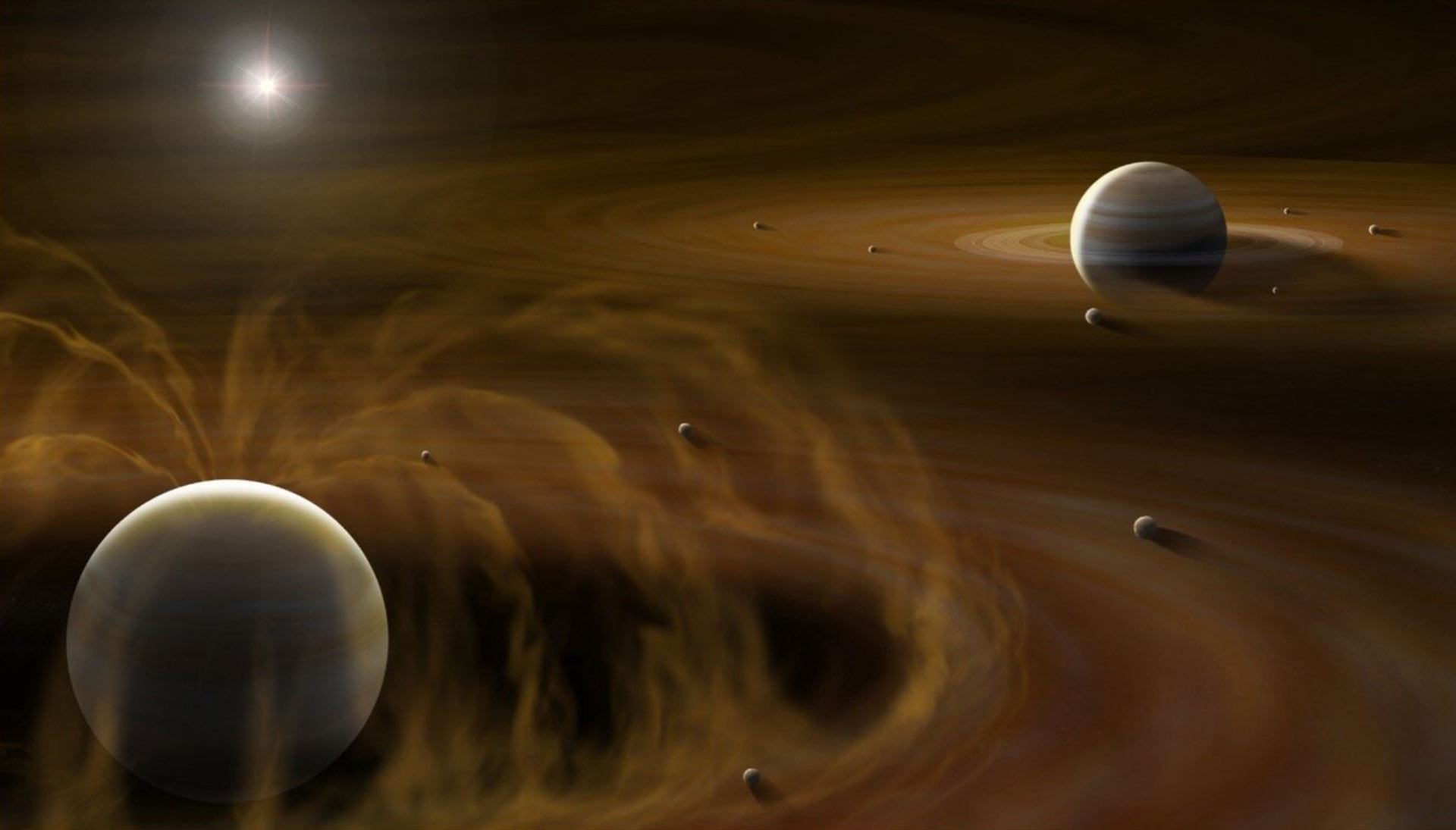
Jupiter (lower left) has a strong magnetic field which creates a cavity in its circumplanetary disk; Saturn (upper right) lacks a strong magnetic field so its circumplanetary disk evolves without a cavity. Image credit: Yuri I. Fujii / L-INSIGHT / Kyoto University / Shinichiro Kinoshita.
“The two largest planets in our Solar System, Jupiter and Saturn, also have the largest satellite systems,” said Dr. Yuri Fujii, a researcher at Kyoto University and Nagoya University, and colleagues.
“At present, Jupiter’s reported moon count stands at more than 100 moons, and along with its many rings Saturn has more than 280 reported moons.”
“Not all these moons are equal, however. Jupiter’s moon family has four large members, while Saturn’s family is dominated by one large moon, Titan.”
“Since both planets are gas giants, the reasons for the differences in these satellite systems have long puzzled astronomers.”
“Satellite formation theories have proposed some possibilities, but recent studies on stellar magnetic fields have hinted at the need to rethink these theories.”
“There is also a long-running debate surrounding magnetic accretion and satellite formation: specifically, whether an inner cavity can be formed in Jupiter’s circumplanetary disk, the accumulation of material orbiting a planet from which satellites may form.”
A physically consistent model that can explain multiple systems, like the satellite systems of Jupiter and Saturn, may be applicable to other planetary and satellite systems beyond the Solar System.
“Testing planet formation theory is somewhat difficult because we have only our Solar System for reference, but there are multiple satellite systems close to us whose detailed characteristics we can observe,” Dr. Fujii said.
To understand the thermal evolution of Jupiter and Saturn and how their magnetic fields have varied over time, the researchers performed numerical simulations on the interior structures of young gas giants.
They also numerically modeled the circumplanetary disks of both planets, and performed N-body simulations to follow satellite formation and orbital migration.
The results revealed that the difference between the large satellite systems around Jupiter and Saturn can be explained by their differing disk structures, originating from the strength of their magnetic fields.
Specifically, Jupiter’s strong magnetic field caused the formation of a magnetospheric cavity in the circumplanetary disk around the young gas giant, which likely captured the moons Io, Europa, and Ganymede.
In contrast, the young Saturn’s magnetic field was too weak to form a cavity so the migrating moons cannot survive in the disk.
“Our findings predict that compact exomoon systems, in cases of massive gas giants, and a couple of distant moons, in cases of Saturn-sized gas giants, will be found in future surveys,” the scientists said.
The results were published April 2 in the journal Nature Astronomy.
_____
Y.I. Fujii et al. Different architecture of Jupiter and Saturn satellite systems from magnetospheric cavity formation. Nat Astron, published online April 2, 2026; doi: 10.1038/s41550-026-02820-x
Source: Read Full Article