





Supervolcanoes, like the one in Yellowstone National Park, don’t just erupt and go quiet — they slowly rebuild. And now, scientists say they’re finally getting a clearer picture of how that happens.
Published in Communications Earth & Environment, the new research focused on Japan’s Kikai caldera, the site of the largest volcanic eruption of the Holocene around 7,300 years ago. Researchers revealed that Kikai’s massive underground magma system is actively refilling. This discovery offers a rare window into how some of Earth’s most powerful volcanoes prepare for future eruptions and could eventually help scientists anticipate them.
“We must understand how such large quantities of magma can accumulate to understand how giant caldera eruptions occur,” said geophysicist Seama Nobukazu in a press release.
Read More: What Happens When Magma and Earthquakes Align in Yellowstone National Park?
What Is a Caldera and How Does It Form?
Some volcanic eruptions are so explosive that they not only release lava but also fundamentally reshape the landscape around them. These supervolcanoes can release enough magma to submerge Central Park seven miles deep. What’s left after these massive eruptions are wide, shallow craters known as calderas.
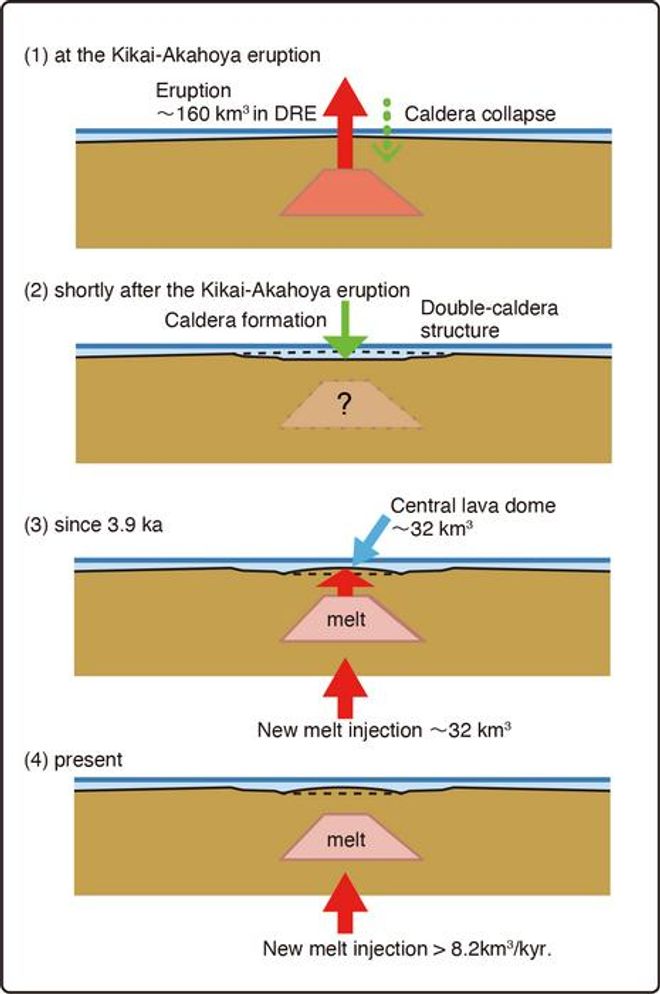
A step-by-step diagram of Japan’s Kikai caldera forming and refilling with magma.
(Image Credit: A. Nagaya et al. (2026), Communications Earth & Environment (DOI 10.1038/s43247-026-03347-9)/CC BY)
These giant depressions form when a volcano empties most of its magma chamber during an eruption. Without that support below, the ground collapses inward, leaving behind a vast basin. Famous examples of calderas include the Yellowstone caldera in the United States and the Toba caldera in Indonesia.
Kikai Caldera, located mostly underwater off southern Japan, is one of these systems, as well. It last erupted in a catastrophic event that reshaped the region. But like other calderas, it couldn’t stay dormant forever.
How Do Calderas Refill Their Magma?
Kikai’s underwater setting turns out to be a scientific advantage.
“The underwater location allows us to implement systematic, large-scale surveys,” explained Nobukazu.
To peer beneath the seafloor, researchers deployed airgun arrays to generate controlled seismic waves, alongside ocean-bottom seismometers to track how those waves moved through the crust. This approach allowed them to map the structure hidden below.
Researchers found a large region rich in magma directly beneath the Kikai caldera, likely connected to the same reservoir that fueled the ancient eruption.
“Due to its extent and location, it is clear that this is in fact the same magma reservoir as in the previous eruption,” said Nobukazu.
But the magma itself appears to be new rather than ancient. Over the past 3,900 years, a lava dome has been slowly forming at the center of the caldera. Chemical analyses showed that this newer material differs from what was expelled in the original eruption, suggesting fresh magma is being injected into the system.
This process is also being seen in other calderas around the world, as noted by Nobukazu: “This magma re-injection model is consistent with the existence of large shallow magma reservoirs beneath other giant calderas like Yellowstone and Toba.”
Why This Matters for Future Eruptions
Supervolcanoes are notoriously difficult to predict. Scientists know they can erupt again, but not when or how the process unfolds underground. This study will help to close that gap.
By identifying how magma reservoirs refill after massive eruptions, researchers are building a general model that could apply to calderas worldwide. That knowledge is essential for improving monitoring systems and identifying early warning signs.
“We want to refine the methods that have proved to be so useful in this study to more deeply understand the re-injection processes. Our ultimate goal is to become better able to monitor the crucial indicators of future giant eruptions,” concluded Nobukazu.
Read More: A Slow-Moving Force Is Silently Sculpting Volcanoes Beneath the Ocean
Article Sources
Our writers at Discovermagazine.com use peer-reviewed studies and high-quality sources for our articles, and our editors review for scientific accuracy and editorial standards. Review the sources used below for this article:
Source: Read Full Article