







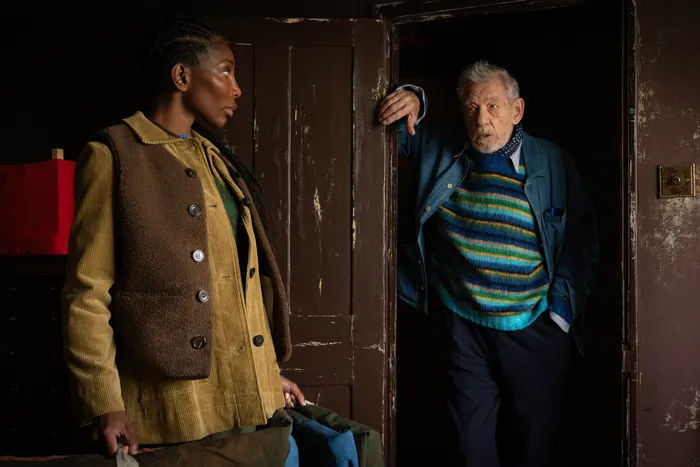
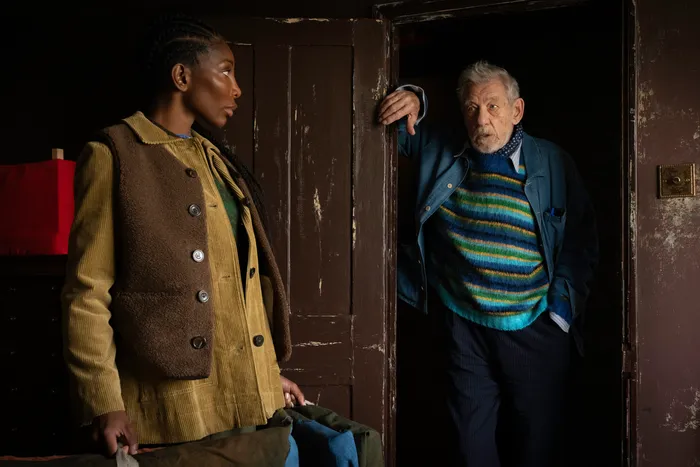
Ian McKellen and Michaela Coel play artists at different ends of the celebrity spectrum in The Christophers, a sly new dramedy from director Steven Soderbergh and writer Ed Solomon. What unites the two main characters is that neither is showing new work anymore or, in the case of Julian Sklar (McKellen), making it at all. The David Hockney–esque Julian was a star of the ’60s and ’70s but has spent the past three decades in prolonged retreat, living off his notoriety and persona as an art curmudgeon — first as a judge on a reality-competition show and, more recently, on Cameo. Lori Butler (Coel), meanwhile, has considerable talent but no career to speak of, working at a food truck to pay the bills and then trudging home with leftovers to her portion of the industrial loft she shares with an indeterminate number of roommates. When her old art-school classmate Sallie Sklar (Jessica Gunning) approaches her, with sibling Barnaby (James Corden) in tow, to propose a mildly nefarious scheme involving Julian, their father, any hesitation on Lori’s part has less to do with ethics than with concerns about whether she can pull off the scheme. Lori will turn out to harbor some personal reasons for loathing Julian, but there are plenty of general reasons to resent him too.
The Christophers is one of those compact pictures Soderbergh tosses out every year with the seeming effortlessness of someone making a stack of pancakes. And like pancakes, they include occasional flubs, though The Christophers isn’t among that number. It’s a deceptively simple feature, a two-hander aside from the scattering of scenes with Corden and Gunning, who are amusingly awful adult babies. But as Julian and Lori engage in what is essentially a prolonged duel, feinting and jabbing across generations, offering up deceptions and hard-fought moments of vulnerability, they become a pair of complex portraits themselves, a diptych of subjects who feel hopelessly wounded by an art world from which they nevertheless want respect. Lori at first presents herself to Julian as a potential assistant, the latest in what has clearly been a long string. But what his failchildren have really hired her to do is complete the unfinished third set of his most famous series of paintings, “the Christophers,” an array of portraits named for their subject, who was also his lover. Filled with barely more than sketches of ideas, the canvases have been sitting for years in a third-floor storage space where, Sallie and Barnaby hope, the secretly completed works can be “discovered” and sold after Julian’s death.
It wouldn’t be interesting if things just went as planned. But The Christophers isn’t a thriller or a heist movie, and its twists are more about its characters than about its narrative. Soderbergh and Solomon conceived of the characters with McKellen and Coel in mind, and the actors are a fascinating and perfect mismatch in energy. McKellen is in his element, prickly and charming and cruel, his Julian so used to performing a theatrical version of himself that he no longer recognizes what he’s doing as a defensive act. Coel, meanwhile, has always been best as an actor in her own work, as though there’s some mercurial quality to her as a performer that others don’t seem able to harness. She shows some of that elusiveness in The Christophers as well, though here it’s put to good use. Where Julian preemptively sets out to offend and dismiss, strategically sucking all the air out of the room so no one has the breath to ask inconvenient questions, Lori turns inward, tamping down all her frustration and pain so not a hint shows on the outside and acting wry to cover up how much she cares. Coel has a showstopping moment in which Lori reveals just how well she knows Julian’s work and how deep an understanding she has of the Christophers, which are, however much Julian tries to downplay it, a document of his defining romance and subsequent heartbreak.
Lori is making a point to Julian, but Coel delivers the lines as though they’re being pulled out of her unwillingly, as if she didn’t want to share these insights. Because, of course, Lori worships Julian’s work, which is the only reason she can hate him so much. A late reveal in Solomon’s script hits like a knife slipped stealthily between the ribs, but in some ways, it’s unnecessary. You have to be passionate about something to know it as comprehensively as Lori knows Julian’s work, which means leaving yourself open to being hurt by it. The comedy in The Christophers comes from its pitch-perfect details. It comes from the clutter of Julian’s two adjacent London townhouses, millions of pounds of real estate for one man to rattle around in and consign a whole floor as a de facto storage unit. It comes from Julian himself, pulling a battered Burberry trench over his bare torso when Lori objects to his half-dressed state and muttering about how he was bisexual back when it meant something. But despite Soderbergh’s light touch, the movie has a melancholy that lingers. Having lost the inspiration that guided him to greatness, Julian is an artist who can no longer paint, and Lori is an artist who has lost all confidence in there being a place for her work in the larger world. For all the undercurrents about fame, commodification, and reputation that flow through The Christophers, at its core is a more plaintive lament about what it feels like to love something that doesn’t love you back.
Source: Read Full Article