




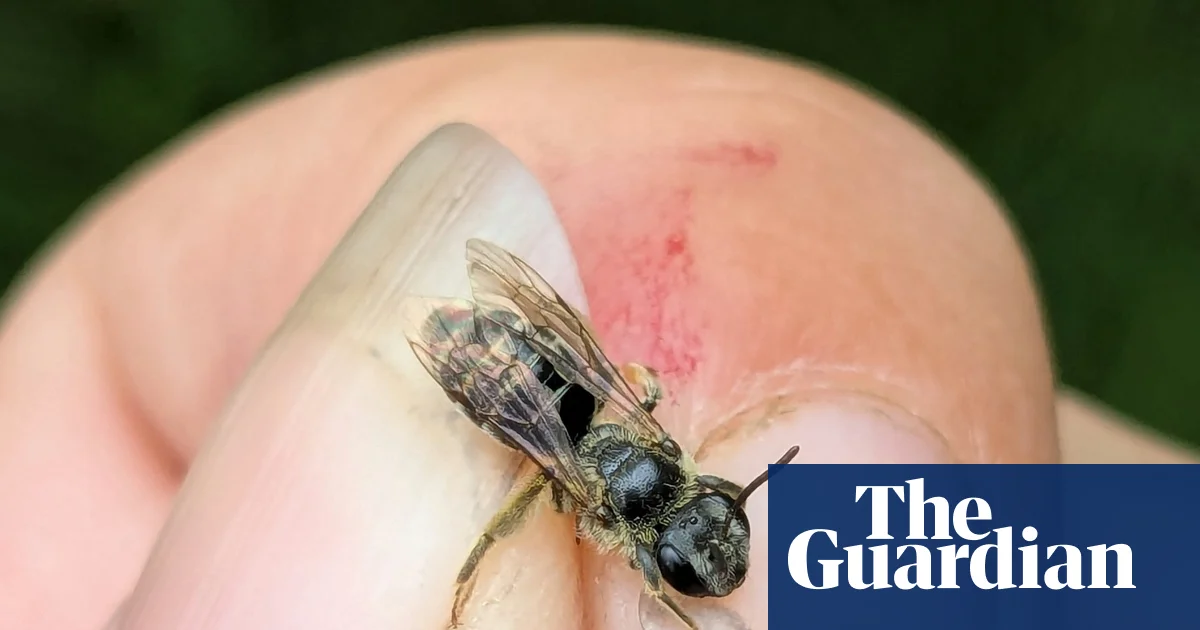
I’ve loved insects ever since I was a kid and spent summers looking for them. My mum would always tell me that from the age of one – even before I could walk – I would happily sit outside, watching ants and trying to follow them back to their colony.
As an adult, I take people out to meadows with nets to catch insects and take a close look at them. It’s about trying to cultivate a childlike curiosity that people have lost or forgotten in daily life.
Every week or so last summer, I worked in a chestnut orchard in the city of Syracuse in New York State. One day, I thought to myself, why have we never surveyed these trees for the chestnut mining bee (Andrena rehni)? It had never been documented in Central New York, not even in museum specimens. In 2022 it was considered possibly extinct by the state as the last record was in 1904. For decades, there were no records of it nationwide.
I was off travelling and had a few minutes spare before packing up to leave. I was just hanging out with my butterfly net – which I always have on me – and I started swinging it around just 10 feet from where I’d spent that summer.
This orchard is in a densely urbanised city, surrounded by highways. You’d think that wasn’t a great landscape for this bee to be in, and yet I had a feeling in my gut that it would be here. The moment of discovery was incredibly exciting. I caught two in 10 minutes – they must have been there the whole time, and yet no one had taken the time to really look.
In the past decade the number of people wanting to track down rare bees has grown exponentially. It is part of a growing effort to search for lost bees. There are many in our museum records that have dropped off the map; we don’t know if they are extinct, or no one is looking for them.
The chestnut mining bee is a holy grail kind of bee, and for the past few years the hunt has been on to find it. It hadn’t been recorded in southern New York for 119 years until I found it in 2023, but it had never been found north of the Hudson valley – until that day in the orchard.
It showed that our efforts to restore chestnut orchards, which were decimated by chestnut blight in the early 1900s, were paying off. These bees, which are totally dependent on them, appear to be coming back.
In the US we have about 450 species of mining bee, and to the untrained eye they look almost exactly the same. It can take many years to learn the skills to identify these small, unremarkable bees. Under a microscope they have details on their exoskeleton that differentiate them – for example, patterns of pits and grooves on the thorax, or the texture of their abdomen. We look at the placement of hair – texture, colour, length and location. If all else fails, we look at their genitalia.
I am of the belief that every place has something interesting; it’s just a question of whether we spend the time looking right under our noses. We often forget about small creatures when they are not flashy. We have to stop working on the assumption that super-pristine habitats are the only things that have great things left in them.
Because of all this, we’ve had people in upstate New York saying they want to survey for the bee. People love to help find things. They could be anywhere – even in your back yard. I can’t emphasise enough the importance of citizen science; we need people to look in their back yards as that’s the place most scientists can’t search. Cities can have amazing things in them.
When I’m out looking for insects, I’m mostly out there for the joy of being outside – insects are everywhere; there will always be things I haven’t seen. I never understood why people couldn’t appreciate them. They are beautiful and central to life on this planet.
The lives of most wild bees are a mystery to us. We don’t know where they nest, or what their nests look like. The less we know, the less we can do to protect them.
When you look a creature in the eye, you have empathy for it. Most people don’t try to get eye to eye with insects. I can say that I have inspired some people to want to protect insects and that’s the only way that conservation is going to work – making people genuinely care about other life forms. I know my younger self would be proud.
As told to Phoebe Weston
Source: Read Full Article