








Growing up in a suburb of the northern Alberta city of Edmonton, it’s easy to get spoiled by northern lights. While they didn’t necessarily happen often, my parents would occasionally wake me in the middle of the night as a child to see a wild laser light show unfold across the big open skies of the northern prairies. On the best of these nights, I remember seeing whole blankets of green draped across the constellations, fluttering in the astral wind as darker blues and purples twisted into tornado-like vortices.
Northern lights, also known as aurora borealis, are much harder to see now that I live in the Washington, D.C. area, but that doesn’t mean it’s impossible. We’re currently experiencing a solar maximum, meaning the chances for seeing northern lights are much greater anywhere on the planet than they were, say, six years ago.
While the northern lights are stunning in Canada, there are many places in the U.S. to catch a glimpse of this colorful phenomenon, including several national parks. Here’s which ones you can visit for optimal viewing.
Read More: The Northern Lights: A History of Aurora Sightings
Alaska Is The Best Place In The U.S. For Northern Lights
By and large, the best U.S. national parks for viewing the northern lights are the seven parks in Alaska, due to their northern latitudes, according to a National Park Service (NPS) spokesperson. One of the best places to track conditions across the state is the University of Alaska Fairbanks (UAF) Geophysical Institute Aurora Forecast website, which provides current conditions, predictions, and trends. For reasons not completely understood, the best times to see the aurora in interior Alaska are around the spring and fall equinoxes, in March and September, respectively.
The farthest north of these, Gates of the Arctic and Kobuk Valley national parks, would be the best places to see aurora views, but these are also among the more difficult parks to get to — Gates of the Arctic has no roads or trails. As a result, there is virtually no light pollution in these parks either, which makes it easy to see the aurora if you are in the area.
When it comes to Alaskan cities, Anchorage is often a little too big and too bright to see the northern lights. Couple this with the fact that there are several smaller towns nearby, which give off a glow that can dampen the visibility of the aurora. But Fairbanks is more remote and more northern.
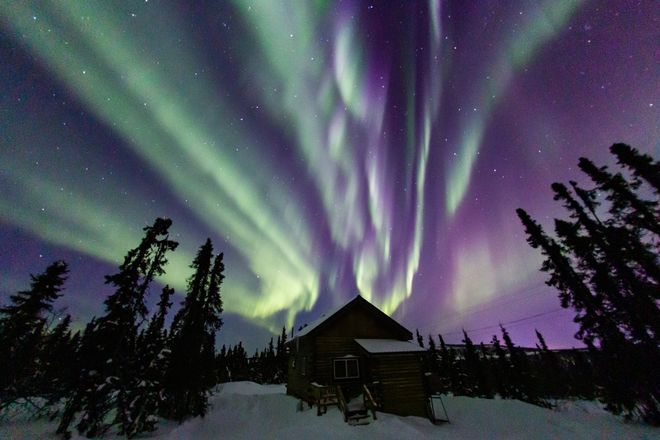
Northern lights in Fairbanks, Alaska.
(Image Credit: Hide’s photos/Shutterstock)
“Fairbanks is definitely the spot for aurora viewing because you have less city lights and it’s more common seeing it there,” Shira Ellenson, a cartographer who has worked on projects mapping out the northern lights with the Imagine and Geospatial Information Society, told Discover.
The closest to Fairbanks, Denali National Park and Preserve, is still plenty north and plenty remote, and often has clear skies — cloudy nights can obstruct your vision of the northern lights.
As far as accessibility, Wrangell–St. Elias National Park and Preserve, and the nearby town of McCarthy, are also good places to see the northern lights. As you get farther south, Katmai, Kenai Fjords, and Glacier Bay national parks are also good options.
Northern Lights in Other National Parks
Outside of Alaska, seeing the aurora borealis isn’t quite as common, but it’s still possible. If there’s a strong enough coronal mass ejection on the sun and it’s pointed towards the Earth, it’s possible to see them much farther south than their usual northern stronghold. In November 2025, for example, aurora were visible as far south as Texas and Florida, according to Texas Public Radio and National Public Radio. Ellenson explained that you can plan to some degree when these things happen as scientists track solar activity.
“All of this is predictable,” she told Discover.
That said, they are still more commonly visible in the most northerly, darkest places. That means, in general, parks in the western interior of the country, in less-populated areas. A spokesperson for NPS said, for example, “it’s not uncommon for them to occur in parks like Voyageurs National Park in Minnesota or Theodore Roosevelt National Park in North Dakota due to their higher latitude.”
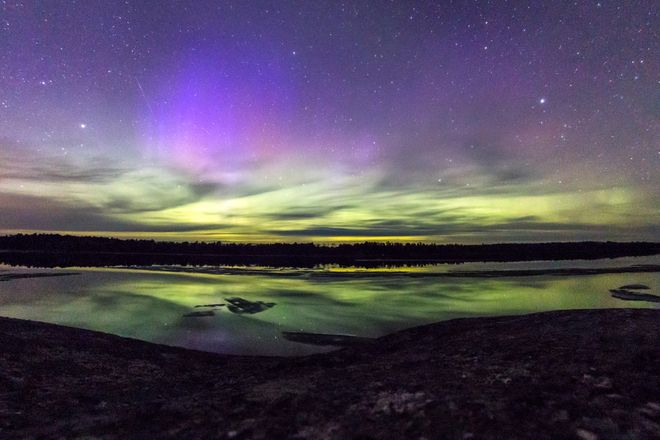
Northern lights in Voyageurs National Park, Minnesota.
(Image Credit: BlueBarronPhoto/Shutterstock)
The NPS also lists Isle Royale National Park in Michigan as a place to see the aurora if the conditions are right.
Glacier National Park in Montana and the adjoining Waterton Lakes National Park in Alberta on the other side of the Canadian border are collectively known as the first International Dark Sky Parks that cross an international border, as recognized by DarkSky International, an organization that works to protect dark night sky from the effects of light pollution.
In most cases, seeing the northern lights will require setting a late-night alarm, as they are most visible when the sky is darkest. Ellenson finds that part of the aurora’s appeal is that they are rare. She was lucky to see them in Missoula, Montana, before, and still gets involved in northern lights-tracking forums online now that she lives in Alaska.
“Winters in Alaska are tough — it’s cold and dark, and you’re entering this sleepy time,” she said. But the spectacular light shows help her get through the winter.
Read More: Aurora Throughout Our Solar System
Article Sources
Our writers at Discovermagazine.com use peer-reviewed studies and high-quality sources for our articles, and our editors review for scientific accuracy and editorial standards. Review the sources used below for this article:
Source: Read Full Article