








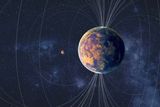
The ebb and flow of Earth’s magnetic field strength — caused by the movement of iron in the core — may have played a crucial role in the development of life on our planet throughout history.
One possible route by which Earth’s magnetic field may have influenced the evolution of life is through cosmic radiation entering during periods of weakened field strength, according to a study in Advances in Space Research.
That happens during flips of the Earth’s magnetic field, an event, according to NASA, that occurs roughly every 300,000 years. Over the last 170 million years, it’s estimated that the magnetic field has flipped over 500 times. Usually, this process takes around 10,000 years as the magnetic poles shift. But in a 2026 paper, researchers found that one flip event — occurring around 43 million years ago — lasted up to 80,000 years.
“The strength of the magnetic field gets really weak during that transitional period,” Peter Lippert, an associate professor in the Department of Geology & Geophysics at the University of Utah and author of that paper, told Discover. “We can think of Earth’s magnetic field as our force field and as an insulator for the planet against cosmic radiation.”
Cosmic Rays and Life Formation
When that force field is weakened, cosmic rays can bombard the planet. Researchers from Stanford have suggested that cosmic rays played an important role in the early formation of life on Earth.
That’s led to suggestions that a massive supernova enveloping Earth’s atmosphere with gamma rays could have shifted evolution in some locations. A study in the Astrophysical Journal Letters suggests that just such an event may have occurred in Africa roughly 2.4 million years ago, with a blast powerful enough to break down animal DNA.
“Cosmic radiation is thought to be a common source of genetic mutations,” Lippert said.
The general hypothesis, he told Discover, is that with a lower magnetic field sustained over a period of time during a flip event, life would be exposed to cosmic radiation at higher rates.
“Therefore, there might be some sort of feedback on mutation rates that gets selected for,” he added.
Read More: How Does Earth’s Magnetic Field Work?
Bringer of Life or Death?
Though a logical conclusion, this hypothesis has proven challenging to test and prove in practice. Cosmic radiation prompting speciation and genetic mutations remains possible, but for John Tarduno, professor of Geophysics and Chair of the Department of Earth and Environmental Sciences at the University of Rochester, the influence of the magnetic field is perhaps greater in other ways.
“It’s more or less accepted that the Earth’s magnetic field is important for life, in the sense of shielding against harmful cosmic radiation,” he told Discover. He is, though, skeptical of cosmic radiation as a significant driver of evolution.
“Because to me, more [radiation] means, well, death,” Tarduno said. “I tend to think of it as more of an extinction mechanism.”
But as there is limited evidence that weakened magnetic fields during flips drive evolution, there is also little sign of mass extinction.
“People have looked for the correlation between extinctions and reversal events, and they haven’t necessarily found those,” Tarduno told Discover.
Low Magnetic Field and an Explosion of Life
It remains possible that radiation has shunted along the development of life on Earth. But for Tarduno, another significant effect is that the weakened magnetic field also causes a leakier atmosphere. That allows hydrogen to escape, and his team hypothesizes that during the Ediacaran period — approximately 635 million years ago to 541 million years ago — oxygenation of the atmosphere may have occurred in the void left by the hydrogen, according to a Communications Earth & Environment study.
That’s because this period coincided with an explosion of life and an extremely low magnetic field, ten or possibly even thirty times weaker than it is today, Tarduno said. That persisted for over 20 million years.
Though the Cambrian explosion — occurring between 539 and 519 million years ago — is when numerous animal groups emerged, the Ediacaran also saw its own evolution of animal life, according to research in Science Advances. During this time, large animals began to evolve, some of them growing to over a meter in size.
“What emerged from this was that we have this extremely low magnetic field, and the timing of that and the evolution of large animals started to become so striking to us that this couldn’t be ignored,” Tarduno said. “In this case, this kind of profound, weakened magnetic field caused environmental factors to change that then allowed the evolution to occur.”
Tarduno stresses that the magnetic field’s weakened state was not the only factor at play during this time; in many ways, evolution was primed to take off.
“This has a pretty profound impact [on] our understanding of evolution, that you know, there was something happening here, if we’re correct, deep in the core of the Earth that eventually assisted in this evolution,” Tarduno told Discover. “That’s kind of a neat way to think about it.”
Read More: Gigantic Hot Rock Blobs Have Impacted Earth’s Magnetic Field For Over 200 Million Years
Article Sources
Our writers at Discovermagazine.com use peer-reviewed studies and high-quality sources for our articles, and our editors review for scientific accuracy and editorial standards. Review the sources used below for this article:
Source: Read Full Article