










Linux has more than a dozen different desktop environments available, and a big part of what differentiates distros is how they choose to customize those desktop environments. POP!_OS used GNOME for most of its history, but in late 2025, they released an entirely new desktop environment called COSMIC.
I used it for a few days to see how it shaped up to classics like GNOME, Cinnamon, and KDE.
What is COSMIC?
A bold new desktop environment
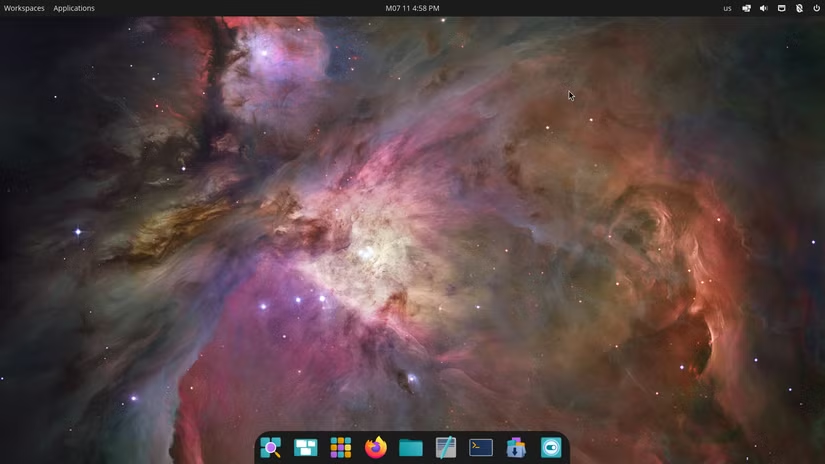
COSMIC (Computer Operating System Main Interface Components) is the new desktop environment that System76 is developing for Pop!OS.
COSMIC was originally derived from the GNOME desktop environment, and if you put the two side by side, you can see GNOME’s influence on some of the design choices.
However, the similarities are fairly cosmetic. Once I started digging in, I found a desktop environment that was quite different.
There is Rust in COSMIC
Part of what makes COSMIC different and interesting in the long term, is the fact that it is written in Rust.
Rust is an object-oriented programming language that is increasingly positioned to be a replacement for C and C++. Microsoft has started using Rust for important parts of the Windows operating system, and they’re aiming to gradually transition over the next several years.
One of Rust’s big selling points as a programming language is that it is “memory safe,” which it achieves by requiring programs to adhere to strict rules when handling memory. In theory, it makes programs written in Rust less vulnerable to certain exploits.

Why Rust is the secret ingredient behind the next generation of Linux
From System76’s COSMIC to rewritten coreutils, Rust is replacing C and C++ in the Linux world. Discover why “memory safety” is more than a buzzword.
Its speed and flexibility have made Rust increasingly popular for high-performance applications and embedded applications, but it isn’t commonly used for user interfaces (yet). That makes COSMIC fairly unique, and in theory, it should mean it is safe, stable, and very performant.
COSMIC has growing pains
A promising project with a few issues
COSMIC had its first major release at the end of 2025, and when I tried it, I was immediately impressed. In general, it is every bit as responsive as you would hope.
However, I ran into some problems.
Applets are still immature and slightly buggy.
GNOME is famous for having an enormous number of optional extensions available, and COSMIC obviously aims to build something similar with their Applets.
The applets I tested meshed nicely with the user interface, but I frequently found that buttons didn’t do anything at all. I could click a dozen times, and it’d just sit there. A restart usually fixed the issue, but it was persistent and annoying.
On a positive note, COSMIC’s Applets will probably be excellent once the ecosystem fully develops. There is even a convenient template available on the Pop!_OS GitHub to help developers get started.
Right-clicking sometimes doesn’t work
For reasons I can’t determine, sometimes right-click is a little buggy. After I installed Discord, I wanted to pin it to the dock, since it is an application that I use frequently.
I had to right-click a few times for the right-click context menu to actually appear like you’d expect. After testing this for a while, I wasn’t able to figure out the source of the problem. Left-clicking other menu items worked as expected, so it wasn’t the entire system freezing up either.
I also sometimes encountered a glitch where the context menu would open, and I could actually click an option, but it failed to disappear automatically.
Neither glitch happens consistently, but I did notice it on a handful of occasions over a few days.
COSMIC has a promising future despite the growing pains
Despite the handful of bugs I experienced—some serious enough to actually interfere with my normal use of the operating system—I really like COSMIC.
The icons are stylish and distinctive, though not so much that it is distracting. The user interface is snappy, and everything is laid out in an easy-to-understand way. The applet ecosystem seems to be growing steadily.
It just isn’t quite at the point where I’d want to use it as my daily driver, or recommend that someone use it that way.
Source: Read Full Article