









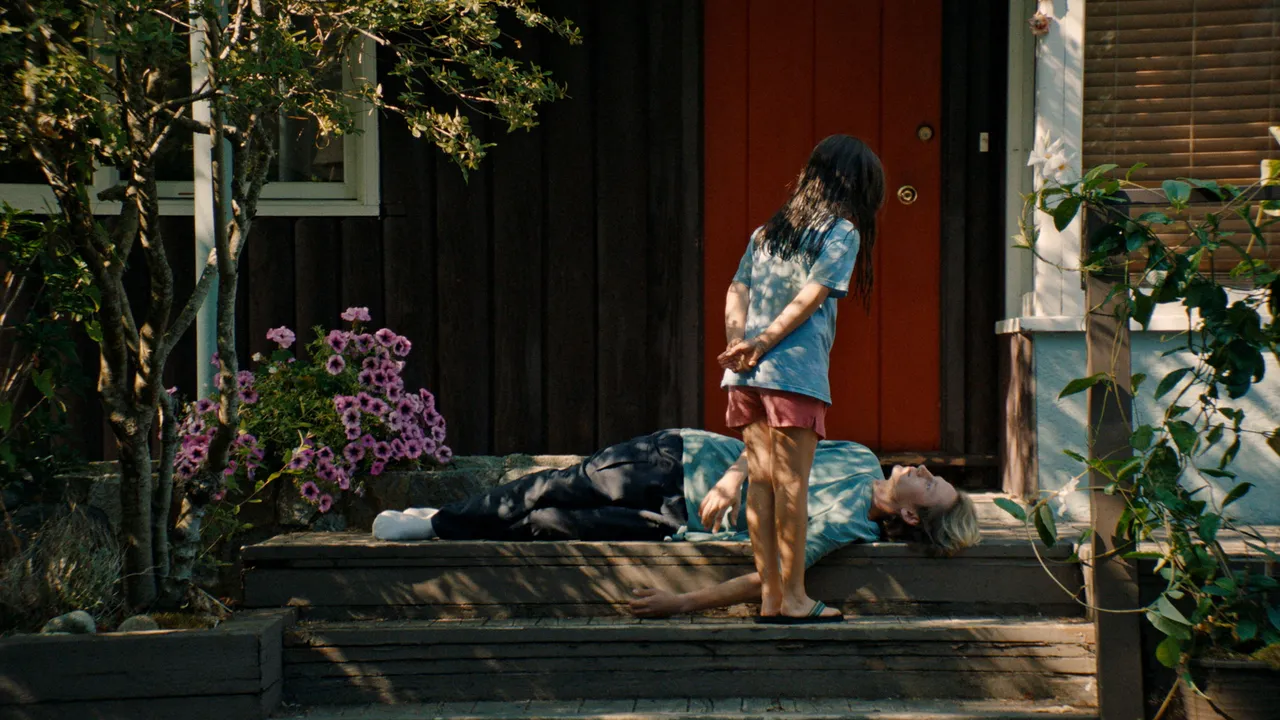
The movie’s fluid observational construction conjures drama by compounding micro-incidents; its narrative emerges from the shaping of young Sasha’s inchoate sensibility as she observes the troubles that surround her. The story is something of a palimpsest, with Romvari’s own perspective intertwining with the character’s and conveying a sense of being both inside and outside the action. Romvari’s images are distinguished by their dual sense of logical efficacy and aesthetic loft. She overcomes the filmed image’s default setting as information, its inherent resistance to revelation, and builds the movie with an unmistakable evocation of Sasha’s point of view, but she does so undogmatically, without limiting herself to the child’s visual perspective. This choice makes those images that do stand in for Sasha’s line of sight all the more startling and forceful. The cinematography (by Maya Bankovic) leaves powerful afterthoughts of dramatic ideas while delivering feelings in real time. Many shots appear to be filmed with telephoto lenses, suggesting, via the camera’s distance from the action, Sasha’s distance from her own past and her struggle to remember. Other times, the camera pans slowly, its drifting movements evoking the associative efforts to make sense of long-ago events. Objects interposed between subjects and the camera hint at the quest for clarity through the intervening years.
Romvari herself grew up on an island in British Columbia, and the natural landscape plays a significant role in her movie’s textures and tones. There are majestic overhead views, grand Pacific sunsets, houses tucked among surrounding forests, their lights showing like fireflies through the foliage. The region plays like a force unto itself, conditioning the mood of the family’s dreamy yet precarious walks on jagged promontories and beach visits from cliff-bound paths. From the opening scene of the family’s move to town, the soft and wistful light shapes the film’s emotional world. The production design (by Victoria Furuya) reinforces the reminiscent tone with details evoking Sasha’s nineties childhood—cordless phone, floppy disks, camcorders. This specific technological moment is played crucially but lightly, gracefully, with a child’s-eye fanaticism for incidentals that anchor moments in memory. The film also highlights, through such enduring artifacts as cassette recordings and photographic prints, the archival basis of memory itself.
Romvari delights in the gleam and glow of children’s play, and she can’t resist showing it tarnished. Sasha makes new friends in the neighborhood, but her parents won’t let her invite them over, for fear that she’ll end up embarrassed at Jeremy’s behavior. The younger two brothers float paper boats in the kitchen sink and Jeremy plays along, sprinkling flour on their heads—but making the kitchen a total mess. In one scene, the kids are bouncing in the back yard on a trampoline when Jeremy returns home with a policeman, under arrest. (The incident endures in iconic fashion—at that moment, Sasha’s father, who was videotaping the jumping kids, hands her the still-running camera.) The actors seem tuned to one another like musicians in an orchestra, and Romvari guides them through performances that feel neither overplayed or understated. Their exchanges take place in a conversational middle range that puts their emotional substance—bewilderment, frustration, anger, quiet despair—into sharp and poignant contrast.
Sasha, the film’s most prominent character, is essentially a Jamesian central consciousness. The real protagonist of the story is Jeremy, whose character is crafted with a daring inventiveness that unites intellectual perspective and love. Though he dominates Sasha’s childhood—and though, in retrospect, his voice seems prominent throughout— he actually speaks very little in the film, and his voice is scantly heard. His few lines of dialogue have a power that far exceeds their word count, but what speaks for Jeremy most of the time are his physical gestures, which blend blank detachment with willful ferocity. His other mode of expression is making maps, detailed ones, which are also works of imagination—one town he’s mapped is called “Fantasyville.” Though these works don’t have a public reach, they nonetheless have a lasting impact on Sasha, and, it turns out, on others.
Some plot twists are just a matter of marketing (see: “The Drama”). The one in “Blue Heron” gave me a thrilling jolt even on a repeat viewing. Suffice it to say that eventually the tale of childhood catches up with the adult Sasha (played by Amy Zimmer), a filmmaker, who attempts to make sense of her past and Jeremy’s fate by undertaking her own investigation, at several decades’ remove. Romvari films Sasha’s efforts by combining authentic documentary elements—the adult Sasha’s interviews with real-life psychologists and social workers—and scenes featuring dramatic monologues of a rare poetic sublimity. With its fusion of memory and history, its blend of nonfiction and torrential imagination, its exploration of the very nature of memory, “Blue Heron” takes a place alongside other recent films, such as “Nickel Boys,” “The Mastermind,” and “The Secret Agent,” that offer similarly original approaches to to the collective and personal past—and to the very terms of its survival, its transmission, its unshakable power. ♦
Source: Read Full Article