









These baby beetles work together to look—and smell—like flowers
Parasitic beetles are the first animals known to imitate floral scents
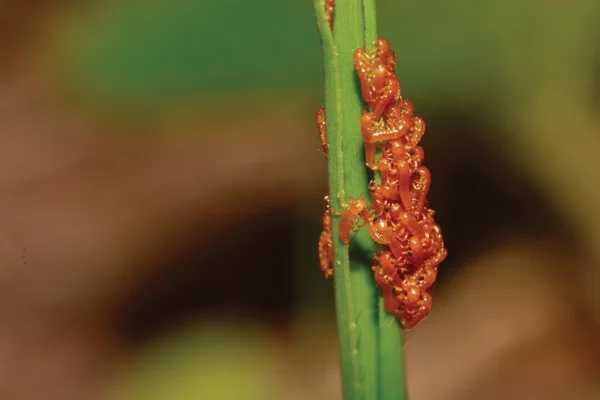
Blister beetle larvae demonstrate a clumpy flower impression.
The European blister beetle lays thousands of eggs in the spring. When they hatch, the bright-orange larvae shimmy up flower stems and sit in clumps, waiting for passing solitary bees to latch on to with hooklike appendages so they can grab a lift. Now researchers have found that these clumps give off a distinctly floral scent—making the larvae the first animal known to mimic a flower’s smell.
Ryan Alam, a chemist at the Max Planck Institute for Chemical Ecology in Germany, and his colleagues found that the larvae attract bees by emitting a collection of 17 scented compounds often found in flowers, including linalool oxide and lilac aldehyde. Once a larva has been airlifted to a bee’s nest, it feeds on the bees’ eggs and supplies of pollen and nectar. It stays there until it pupates and then leaves as an adult to restart the cycle.
In addition to attracting bees, the larvae’s perfume also draws other larvae, which could help them to form those flowerlike aggregations. The study was posted on the preprint server bioRxiv and hasn’t been peer-reviewed, but it “presents a convincing case that the beetle larvae are mimicking flowers chemically, and perhaps visually, so as to deceive and attract bees,” says Jim McLean, an evolutionary biologist at Macquarie University in Australia, who was not involved in the study.
On supporting science journalism
If you’re enjoying this article, consider supporting our award-winning journalism by subscribing. By purchasing a subscription you are helping to ensure the future of impactful stories about the discoveries and ideas shaping our world today.
Animals such as the orchid mantis mimic the look of flowers, and the corpse flower emits a smell like rotting meat to attract insects, but these beetles add a new strategy to the mimicry playbook, Alam says.
Dmitry Telnov, an entomologist at the Natural History Museum in London, who was also not involved in the study, notes that a different blister beetle species in the U.S. can mimic the sex pheromones of host bees. Mimicking smells “might be an evolutionary approach used by blister beetles to attract specific species,” he says, “which is absolutely surprising.”
It’s Time to Stand Up for Science
If you enjoyed this article, I’d like to ask for your support. Scientific American has served as an advocate for science and industry for 180 years, and right now may be the most critical moment in that two-century history.
I’ve been a Scientific American subscriber since I was 12 years old, and it helped shape the way I look at the world. SciAm always educates and delights me, and inspires a sense of awe for our vast, beautiful universe. I hope it does that for you, too.
If you subscribe to Scientific American, you help ensure that our coverage is centered on meaningful research and discovery; that we have the resources to report on the decisions that threaten labs across the U.S.; and that we support both budding and working scientists at a time when the value of science itself too often goes unrecognized.
In return, you get essential news, captivating podcasts, brilliant infographics, can’t-miss newsletters, must-watch videos, challenging games, and the science world’s best writing and reporting. You can even gift someone a subscription.
There has never been a more important time for us to stand up and show why science matters. I hope you’ll support us in that mission.
Source: Read Full Article