






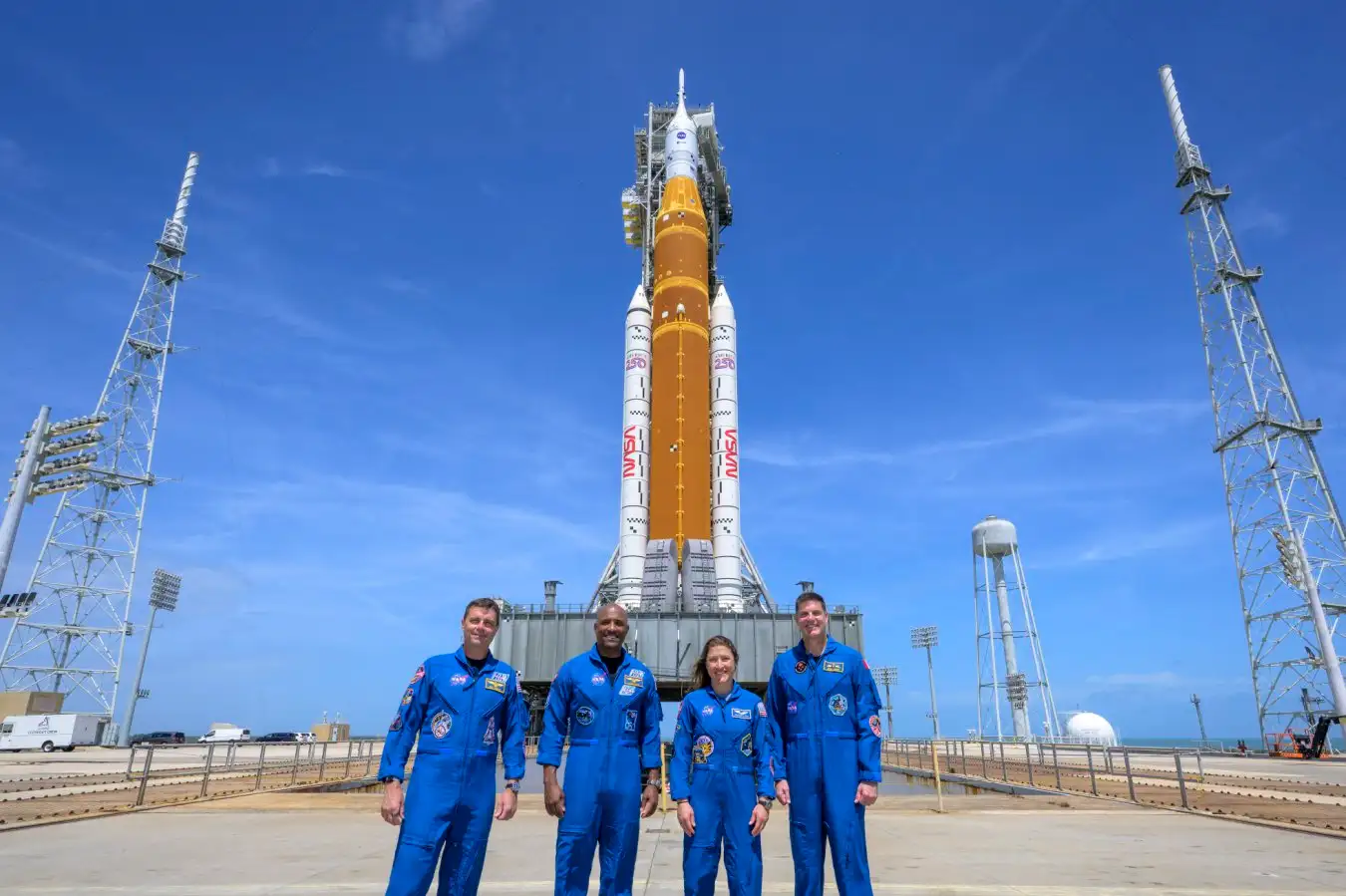
The Artemis II astronauts and Space Launch System rocket at Cape Canaveral, Florida
Bill Ingalls/NASA/Getty Images
Four astronauts are preparing to see the moon as it has never been seen before. NASA’s Artemis II mission, which could launch as soon as 1 April, will send astronauts looping around the moon for the first time since 1972, taking in areas of the far side that no human eyes have ever gazed at.
In the original plan, Artemis II was meant to fly in 2019, but a variety of delays meant that its precursor, Artemis I, didn’t get off the ground until 2022. Artemis I, an uncrewed mission around the moon, was the last time the Space Launch System (SLS) rocket and Orion crew capsule flew.
Its successor will repeat a similar flight, this time with four crew members onboard: Reid Wiseman, Victor Glover and Christina Koch from NASA and Jeremy Hansen from the Canadian Space Agency.
A “wet dress rehearsal” in February revealed issues with the spacecraft – primarily small fuel leaks – that forced NASA to roll the rocket back inside from the launchpad. Now, with those leaks patched, it is back on the pad and ready to launch, and the astronauts are in quarantine, preparing for the mission to begin.
In a press conference on 29 March, mission commander Wiseman emphasised that Artemis II is a test flight for SLS and Orion. “This is the first time that we’re going to try this. This is the first time that we’re loading humans on board,” he said. “The four of us, we are ready to go, the team is ready to go, the vehicle is ready to go, but not for one second do we have an expectation that we are going. We will go when this vehicle tells us it’s ready.”
If the rocket doesn’t go up before 6 April, the next launch opportunity is on 30 April, and there are more chances in May and beyond.
Once the rocket launches, it will orbit Earth for two days before heading off to the moon. In those two days, the crew will test the life support systems as well as docking with an old spacecraft by manually piloting the Orion capsule. Then, they will spend the next eight days or so flying around the moon and back.
When they do so, there will be parts of the far side illuminated, such as a large crater called Mare Orientale, that have never been seen before except by satellite. “We think – I know I did when we started training for this mission – that we’ve been to the moon. Apollo was at the moon. They’ve seen the whole far side of the moon. But, actually, it turns out that there is about 60 per cent of the far side, I think, that has never been seen by human eyes,” said Wiseman.
Artemis II is one step on the long road of the greater Artemis programme. Originally, the third phase was intended to include the first moon landing since the end of the Apollo programme in 1972, but recent changes pushed the landing back to Artemis IV. Instead, the next mission will remain in orbit around Earth and give astronauts a chance to practise docking with the lunar lander or landers that will accompany later missions. Artemis III is scheduled for 2027, and Artemis IV and maybe also V are planned for 2028.
If all goes to plan, the culmination of these missions will be a permanent moon base and a sustained human presence on the moon. “We’re happy to do our small part, our small drop in the bucket, and then hand the baton on when we get back,” said Hansen in the press conference.
Topics:
Source: Read Full Article