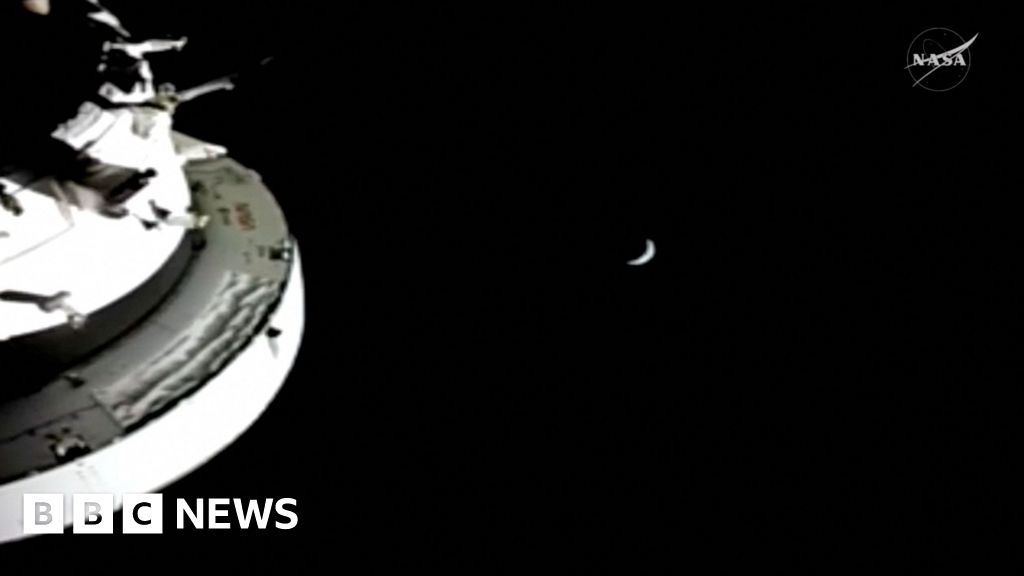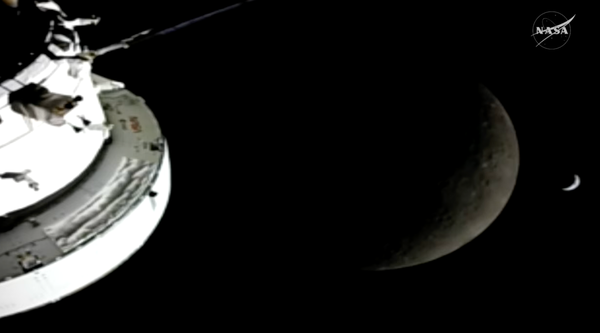










The Artemis II mission crew is laying eyes on parts of the moon that have never been seen in full by humans. Most recently, the four astronauts aboard Artemis II caught sight of the Orientale basin, a feature often described as a lunar equivalent of the Grand Canyon. According to posts on NASA’s various social media pages, this marks the first time the entire basin has been seen with the human eye.
The origins of Orientale basin (also referred to as Mare Orientale, Latin for the “eastern sea”) have long intrigued scientists, who consider it to be the best preserved multi-ring basin on the moon. As such, it’s seen as an ideal model for understanding the types of impacts that shaped not just the moon, but several planets in the Solar System.
A Bullseye on the Moon
Like other multi-ring basins, Orientale basin looks something like a giant bullseye. The depression at its center is surrounded by three concentric rings of elevated rock. The structure, located on the western limb of the lunar nearside, is difficult to see from Earth and is only partially visible through telescopes.
The structure, which stretches nearly 600 miles across, is the youngest multi-ring basin on the moon, likely forming about 3.8 billion years ago. Its formation would’ve occurred during the final years of the Late Heavy Bombardment, a hypothesized period of Solar System history when the inner terrestrial planets are believed to have been battered by a volley of asteroids and comets left over from planet formation.
According to the Lunar and Planetary Institute, Orientale basin is so valuable for studying this chaotic era of the moon’s history because, unlike other basins on the moon, it is relatively unflooded by mare basalts — volcanic rock that covers portions of the lunar surface, leaving what look like dark spots on the moon. As a result, Orientale basin is exposed, allowing study of its original impact melt.
Read More: Scientists Are Still Pondering These Mysteries of the Moon
A Collapsing Crater
The exact process that created the three concentric rings of Orientale basin has been debated in the past, but a 2016 study published in Science found with a plausible answer. Researchers modeled the basin’s formation using information from NASA’s GRAIL (Gravity Recovery and Interior Laboratory) mission, which consisted of two orbiting spacecraft that measured changes in the moon’s gravity caused by features like mountains and craters.
The gravitational field map produced by this mission offered a new view of Orientale basin’s rings. Based on the results of the GRAIL mission, the researchers behind the 2016 study proposed that the asteroid impact that formed Orientale basin left a crater approximately 199 to 286 miles (320 to 460 km) wide.
The deep crater, though, quickly collapsed, causing surrounding material to flow inward. According to a statement from Brown University on the study, this caused the crust above to slip and crack, forming the tall cliffs of the basin’s two outermost rings (a separate statement from Imperial College London explains that these cliffs are several times taller than the Grand Canyon).
The innermost ring, on the other hand, was originally a mound at the center of the crater, but because it was too large to remain stable, the material flowed back out to form a third ring.
A Model for Multi-Ring Basins
Future studies of Orientale basin may shed light on similar multi-ring basins across the Solar System, including several on Mars, the Caloris basin on Mercury, and the Valhalla crater on Jupiter’s moon Callisto.
As for the Artemis II crew, more lunar wonders await them as their historic moon flyby continues; they will also see the far side of the moon and briefly witness a solar eclipse as the moon passes in front of the sun.
Read More: Major Changes to NASA’s Artemis III and Artemis IV Missions to the Moon
Article Sources
Our writers at Discovermagazine.com use peer-reviewed studies and high-quality sources for our articles, and our editors review for scientific accuracy and editorial standards. Review the sources used below for this article:
Source: Read Full Article