









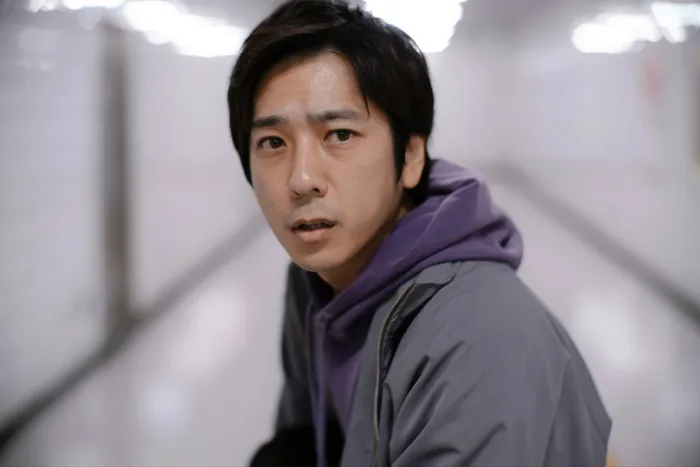
Photo: Neon/Everett Collection
Exit 8 may be based on a video game, but it feels at least equally guided by the ear-popping pressures caused by a declining birth rate. Before it ever gets to its main action, which involves an infinitely looping set of tile-lined hallways in the depths of the Tokyo metro, director Genki Kawamura’s eerie thriller opens with an incident involving a young mother getting harassed on the subway. The scene unfolds from the POV of its main character, credited only as the Lost Man (Kazunari Ninomiya), who’s commuting on a crowded train. In a sea of gray-toned suits and uniforms, the woman trying to soothe her crying baby comes across as an outlier even before a belligerent young salaryman starts screaming at her for disturbing the peace. “Who brings a baby onto a train during rush hour?” he demands, as though public space itself has implicitly been ceded to adults, with children now an uncommon enough occurrence that he’s lost all capacity to deal with their behavior. Rather than intervene on the distressed woman’s behalf, everyone else avoids eye contact, keeping their faces glued to their phones — including our ashamed hero, who’s about to get a call that will put him face to face with the possibility of fatherhood himself.
2023’s The Exit 8 is a wisp of an indie game in which the player navigates a series of train-station passages that form a seemingly closed circuit. The only way forward is to scour the space for signs of anything out of the ordinary, from changes in the ads on the wall to a sudden flood that threatens to wash you away, and to turn back if there’s an anomaly. The experience owes a debt to Hideo Kojima’s influential 2014 game P.T., which also featured a never-ending hallway, though The Exit 8’s aims are more eerie than overtly scary — more institutional Gothic, less by way of Eraserhead’s writhing fetuses in sinks. Alongside unsettling vibes, it offers basically nothing by way of a narrative, which frees Kawamura and his co-writer, Kentaro Hirase, to invent one that complements the limbolike central device of the game with gratifying artfulness. The Lost Man’s purgatorial journey begins after a phone call from his recent ex (Nana Komatsu), who informs him she’s just learned she’s pregnant and asks what he wants to do next, a prospect that has him grabbing for his inhaler in an asthmatic panic. Anxiety about fatherhood runs through the movie like an artery, not just in the Lost Man’s dread about his own inadequacy, as seen in his failure to intervene on the train, but in the backstories of the other figures he’ll meet as he tries to make it out of his nightmarish scenario.
There’s an elegance to the way that Kawamura incorporates his theme into a very straightward premise, making the movie feel like it’s building on the essence of its source material rather than being trapped by so many mobius passageways. The internet’s interest in so-called liminal spaces, out of which the upcoming A24 horror movie Backrooms also spawned, is largely aesthetic — a celebration of the unintentional uncanniness of places like waiting rooms, shopping-center atriums, and, yes, hallways, that are impersonal and transitory and that take on a plaintive quality when they’re stripped of the crowds they’re meant to accommodate. The stretch of passages the Lost Man finds himself repeatedly trudging through, with its tile walls, buzzing fluorescents, and metal emergency doors, isn’t a place that anyone’s meant to spend much time in, or even notice, but the only way he can escape is to pay it close attention. Exit 8 manages a few genuine creepouts, including one involving a businessman (Yamato Kochi) who obliviously walks by on cue until the time he does not. (The most upsetting turn the movie takes is one that lets us know this human-shaped accessory was not always an NPC.) But it’s mostly content to bask in the claustrophobic nature of its impossible setting with long gliding takes, emphasizing that its protagonist is stuck somewhere in between, and wasn’t sure where he was going to begin with.
There are eight circles of hell in Dante’s Inferno, and the characters in Exit 8 have to make it through eight flawless loops to get out of their predicament. One character wonders out loud if they’re dead, but the movie doesn’t hint that they’re trapped in some horrifyingly mundane version of the afterlife. Instead, it suggests that the Lost Man has already been living in his own sort of waking netherworld, working a part-time job, allowing his relationship to peter out, and generally trudging noncommittally through life without making any decisions. Ninomiya plays the character as someone who’s only half-formed, who’s afraid of fatherhood because he himself grew up without a father, but who also hasn’t appeared to commit to anything in life, even as he’s numbly reached adulthood. Exit 8 is a thriller about how the idea of being a parent can become so abstract that it feels immense and terrifying, but that it’s not actually that daunting to decide to be there for another person, whatever that might mean. It can’t be harder than walking the same passages on repeat day after day and paying so little mind that you don’t realize you’re not getting anywhere.
Source: Read Full Article