








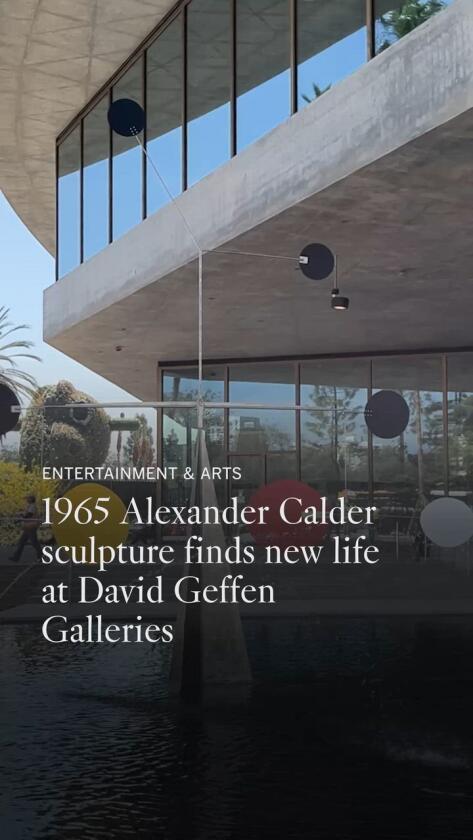
What’s old is new again as sculptor Alexander Calder’s monumental “Three Quintains (Hello Girls)” is installed to anchor the northeast corner of Los Angeles County Museum of Art’s new David Geffen Galleries. The four water jets that propel the colorful, whimsical sculpture were turned back on in March more than 60 years after the piece was first commissioned for the museum’s original William Pereira–designed campus, which opened in 1965.
“The concept of museums commissioning artists is now commonplace. It wasn’t commonplace then,” said LACMA’s senior curator and modern art department head, Stephanie Barron, as she watched the fountain’s bright yellow, red and blue mobile-like paddles dance and twist in the wind and water, alongside Sandy Rower, Calder’s grandson and head of his foundation.
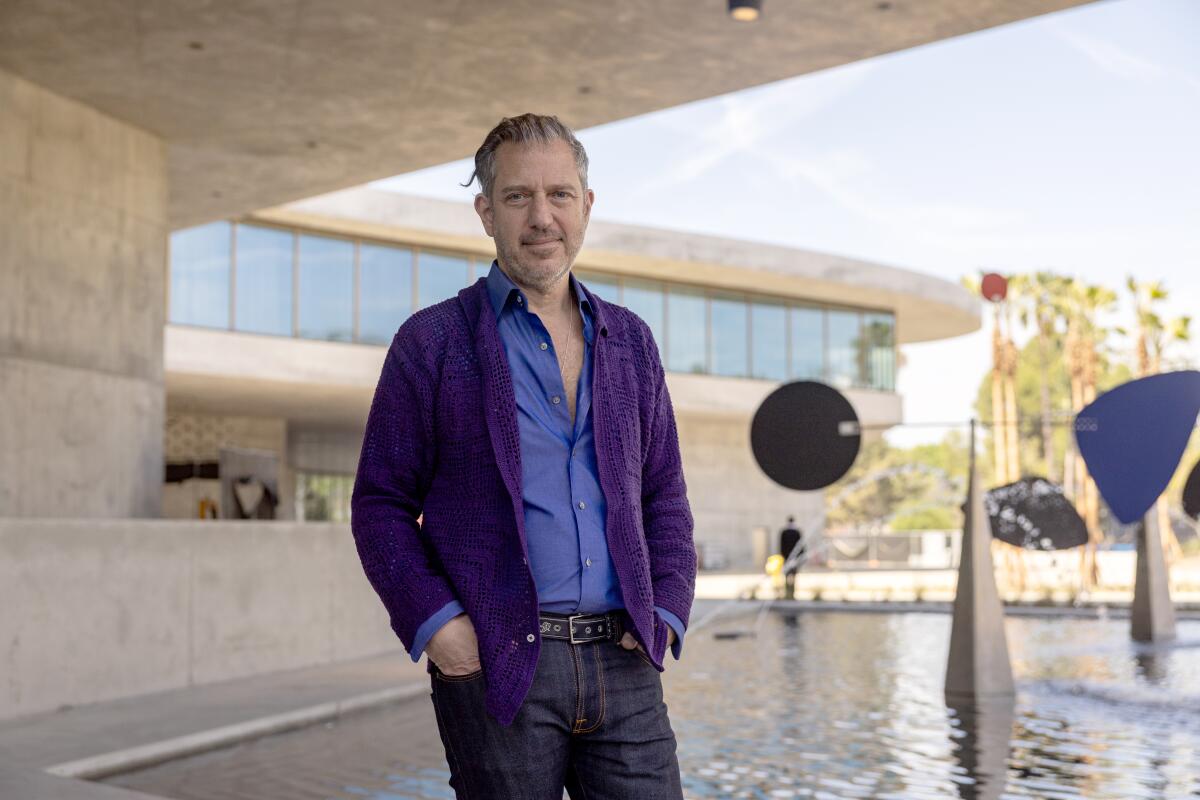
Sandy Rower, sculptor Alexander Calder’s grandson and the head of the Calder Foundation, stands beside his grandfather’s 1964 fountain, “Three Quintains (Hello Girls),” which was just installed at Los Angeles County Museum of Art’s new David Geffen Galleries.
(Etienne Laurent / For The Times)
Not only was the sculpture, fondly referred to as “Hello Girls,” one of the museum’s earliest prized attractions, Calder also designed a poster commemorating the museum’s opening, causing his imprint to be baked into the DNA of the place, noted LACMA’s director and chief executive, Michael Govan.
That’s why discussions about where “Hello Girls” would land began very early in the process of designing the new building, said Rower, adding that he even addressed the matter with architect Peter Zumthor.
-
Share via
“At one point, it was across Wilshire by the theater,” Rower said. “And then it really became clear that this is the site related to all the activity.”
The activity in question will come from the sculpture being directly alongside the building’s main cafe, with outdoor tables flanking the fountain’s edge, and just a stone’s throw from the W.M. Keck Education Center, which will be overrun by excitable children who will get a big kick out of the fountain’s inviting whirl and swirl.
“Kids coming over here are gonna love it,” Rower said. “So are people that have been obsessing on modern art and modernism all their lives — they’re gonna be confounded by it.”
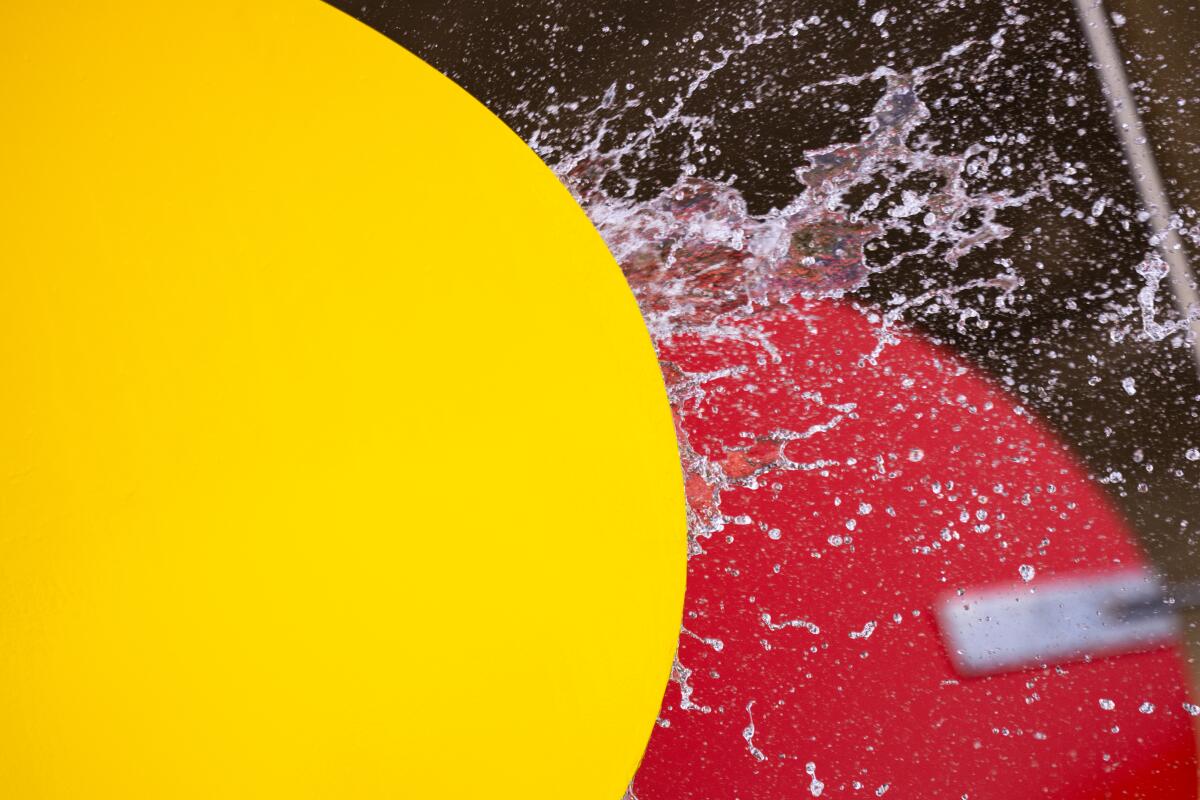
The mobile-like paddles on Alexander Calder’s 1964 fountain, “Three Quintains (Hello Girls),” are propelled by the force of water from four jets, as well as the wind.
(Etienne Laurent / For The Times)
Barron said getting the placement of the sculpture just right was of utmost importance to the museum and the Calder Foundation. Over the years the installation has encountered a variety of difficulties that kept it from realizing its true spirit and form. It was originally situated in pools that people could walk through, but calcium deposits from the water, its proximity to the La Brea Tar Pits and other environmental factors resulted in the sculpture not being “happy,” Barron explained. In the 1980s it was stranded on a hillside in the sculpture garden and later sent for display at Pasadena’s Art Center College of Design.
Anticipation is high with this latest installation, which features a technically advanced filtration system to deal with the perils of an outdoor urban environment, and once again finds the sculpture as its creator intended: at LACMA, surrounded by water.
“Calder is perennial,” Rower said. “A lot of people who arrive here not knowing anything about this artist will be excited that there isn’t a bronze here or something static. There’s activity, there’s color, there’s motion, there’s light, there’s food, there’s a ramp. You can go all the way around it, which is also really nice.”
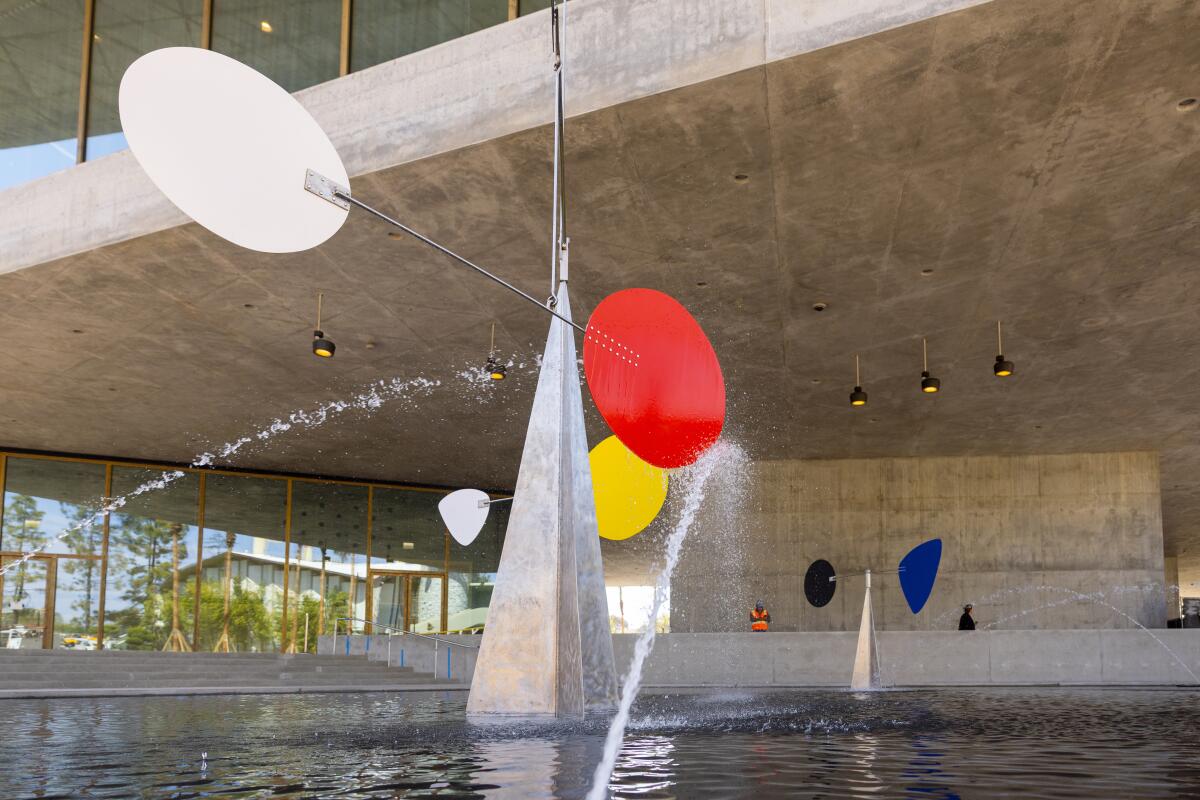
“Three Quintains (Hello Girls)” is installed by the cafe at Los Angeles County Museum of Art’s new David Geffen Galleries. The location was chosen because of all the activity that is anticipated in the area.
(Etienne Laurent / For The Times)
The ability to observe the piece from a 360-degree vantage point allows viewers to see the “balletic nature of the wind and the water,” said Barron, adding that she has enjoyed watching people’s reactions to the installation as it’s gone up.
“People who haven’t been here for a long time say, ‘Oh my God, it’s back. It’s my favorite piece. It looks so much better. It looks different.’ And people who’ve never seen it say, ‘Oh, wow. This just makes me happy.’”
Rower nodded, smiling as the wind pushed a large blue paddle counterclockwise.
“I think your grandfather probably would be really happy with that,” Barron said.
Source: Read Full Article