








Where the Andean mountains meet the biodiverse Amazon rainforest, a unique ecosystem is born. The blend of varying altitudes and abundant water creates niches for species found nowhere else. Since this region holds one of the highest concentrations of biodiversity on our planet, new species are constantly being discovered.
One recent find is a new glass frog species spotted by researchers from the Pontificia Universidad Católica del Ecuador near the Peruvian border. Inspired by athlete Neisi Dajomes, the first Ecuadorian woman to win a gold medal at the 2020 Olympic Games in Tokyo, the amphibian was named Nymphargus dajomesae in her honor.
As their name suggests, glass frogs stand out due to the relatively transparent skin on their underside, giving us a glimpse of their beating hearts and other internal organs.
A Glass Frog With Less Transparent Skin
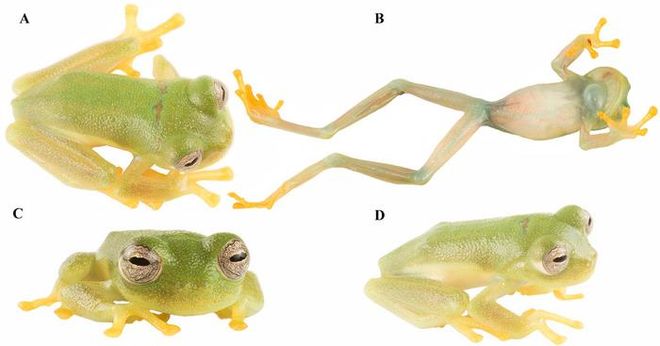
New species of glass frog Nymphargus dajomesae named after Ecuadorian Olympian
(Image Credit: Masache-Sarango et al., 2026, PLOS One, CC-BY 4.0 (https://creativecommons.org/licenses/by/4.0/))
During an expedition in the El Quimi Nature Reserve, located in the southeastern Ecuadorian Amazon alongside the Cordillera del Cóndor mountain range, researchers discovered the Dajomes glass frog for the first time between 2017 and 2018.
In their study, published in PLOS One, the team of scientists describes how this little frog stands out from the rest of the glass frog family. While its back is green with a pebbly texture, its underside is white and contains light-reflecting cells where the heart, esophagus, stomach, and kidneys are located. This specific adaptation makes N. dajomesae less transparent compared to other glass frog species, which often have nearly perfectly transparent belly skin.
However, DNA analysis clearly identifies the Dajomes frog as part of the wider glass frog family. By comparing its genetic material to that of its relatives, the researchers also pinpointed the species’ emergence during the Pliocene Epoch, around 4.5 million years ago.
Read More: A Massive, Ancient Network of Cities Flourished in the Amazon for 1,000 Years
Unique Environments Can Complicate Research
The glass frog family consists of around 167 tree-loving members, with their highest concentration found where the tropical Amazon lowlands meet the northern Andes. The Nymphargus genus is typically found at elevations above 3,000 feet, but there’s still a lot of uncertainty about their exact distribution and morphological variation, as the challenging terrain makes them difficult to access.
Although most glass frogs have been the subject of several studies aimed at understanding their diversity and relationships among species, many remain undescribed or are confused with other frogs. This can result in misrepresentation of lineages in official records or museum collections.
The combination of remote terrain and complex geography in the Cordillera del Cóndor mountain range creates such a unique environment that it hosts at least 23 endemic frog species — meaning they’re found nowhere else in the world. Unfortunately, this also makes them highly vulnerable to environmental changes.
The Lost World of Amphibian Diversity
Although researchers found N. dajomesae near an agricultural region and a large mining area, both known to threaten local amphibian populations, the glass frog’s conservation status is still unknown.
The Dajomes glass frog wasn’t the only species found during the El Quimi Nature Reserve expedition.
“We were astonished by the high number of new species found at the site. Few places in the tropical Andes harbor amphibian assemblages as novel as the one found at El Quimi,” noted the authors in a press release.
They further described in the statement that more than 85 percent of the amphibians the researchers observed were unknown species. This led the team to call the region the “lost world of amphibian diversity,” as they hope for ongoing biodiversity surveys and species identification in the area.
“It is especially meaningful that this discovery is led by a young woman scientist and [honors] an Ecuadorian Olympic champion,” said study co-author Diego Cisneros from the Universidad San Francisco de Quito, Ecuador, in the release, addressing biology student and the study’s first author, Mylena Masache.
“This species becomes a symbol of how science and society can [recognize] and celebrate women shaping the future.”
Read more: Meet 10 of the World’s Most Adorable Frogs
Article Sources
Our writers at Discovermagazine.com use peer-reviewed studies and high-quality sources for our articles, and our editors review for scientific accuracy and editorial standards. Review the sources used below for this article:
Source: Read Full Article