







Earlier in his career, the Ukrainian director Sergei Loznitsa alternated between documentaries and narrative features. The documentaries tended to be distanced, austere, observational; those that focused on the past (such as 2005’s Blockade, about the WWII siege of Leningrad, or 2019’s State Funeral, about the funeral of Stalin) were often built entirely from archival footage. The narrative features, however, such as 2010’s My Joy or 2017’s A Gentle Creature, were rich, rambling, surreal, maximalist, following characters on absurd quests through cross sections of bureaucracy and society. In recent years, particularly after Russia’s invasion of Ukraine, Loznitsa has focused on documentaries, be they about the war raging in his country or the Soviet past. Two Prosecutors, his first narrative feature in seven years, combines the different strains of the director’s filmography. It’s the slowly mesmerizing and Kafkaesque story of a young lawyer seeking justice in 1937, at the height of Stalin’s brutal purges, but it’s marked by an elegant stoicism that suggests Loznitsa might be heading in new directions stylistically — that the rigor of his documentaries is bleeding further into his narrative work.
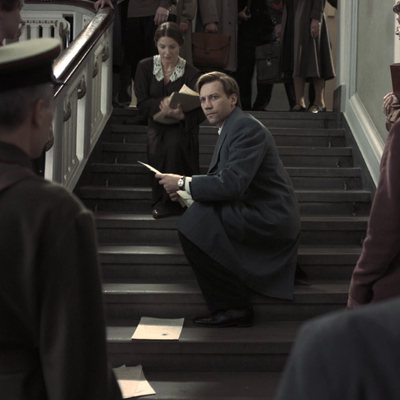
Two Prosecutors is based on a novella by Georgy Demidov, a physicist who spent 18 years in Soviet prison camps and was rehabilitated in the late 1950s, only to then have his work seized by the authorities; most of his writings were only published following his death in 1987. I haven’t read the story the film is based on, but it would probably sound painfully simple in précis: A young lawyer, Kornyev (Aleksandr Kuznetsov), arrives at a prison in the Western Russian town of Bryansk and insists on a meeting with a political prisoner, Stepnyak (Aleksandr Filippenko). Despite several roadblocks from the authorities, he finally meets with the man, an elderly Bolshevik who claims he was jailed under false pretenses and shows him his wounds from the torture he’s endured in captivity. Kornyev then travels to Moscow to speak directly to the country’s chief prosecutor, the prim and poker-faced Andrey Vyshinsky (Anatoliy Beliy), to plead with him to open an investigation into Stepnyak’s treatment. I won’t reveal what exactly happens next, but let’s just remember that the movie is set during Stalin’s Great Terror. Such tales tend not to end well. (And Vyshinski was one of the most notorious figures of the Stalin era, a craven opportunist who made up for his compromised, non-Bolshevik past by becoming one of Stalin’s most loathsome and loyal lackeys.)
What distinguishes Two Prosecutors is not its overall narrative trajectory (which reads more like a bitter cosmic joke than anything else) but rather how Loznitsa subtly colors in Kornyev’s journey through the halls of power. The idealistic young prosecutor knows the law, and he understands both his and the prisoner’s rights. He even grasps, to some extent, the ways in which the law has already been thwarted: In going to Vyshinski in Moscow, he knowingly bypasses the local authorities in Bryansk (and travels hundreds of miles) because he knows they’ve been infiltrated by corrupt secret police. But in the upside-down universe of Stalin’s Russia, Kornyev’s diligence and persistence may well be his greatest failings. Both the prison’s duty officer and the warden regard him with bemusement curdling into contempt, and by the time he arrives at Vyshinski’s offices, the looks the young man gets are of the kind generally reserved for meddlesome pests.
“Our entire lives are structured as a chain of various rituals,” Loznitsa told me when I interviewed him in 2022. “Even when we meet each other and shake hands, this is a ritual.” At the time, he was talking about the fact that both his documentaries and his narrative features often include ceremonies, celebrations, speeches, weddings. Two Prosecutors doesn’t have any sequences that we might typically describe as rituals — except that it does, in fact, feature lots and lots of scenes of people meeting each other. The whole movie basically unfolds as a series of conversations in smallish rooms, almost all of which are eventually revealed to be part of one big empty procession. Kornyev thinks he has agency; he assumes he’s moving up the chain of command; he believes that by going above everyone’s heads he’s outflanking the criminals who’ve sullied Soviet justice. In fact, he’s unwittingly enacting a charade, each step on his path more meaningless than the last. He is heading straight into the lion’s den — because Soviet justice has itself become a monstrosity.
Loznitsa’s locked-down style echoes this idea on a formal level. The camera pretty much never moves, not even slightly. Characters are almost always framed by walls and doors in ruthlessly direct compositions that evoke a stylistic prison to go along with the real ones. Early in the film, two men laugh uproariously (too uproariously) at a throwaway joke about a Soviet official who said that before the revolution he was waiting for jail and after the revolution “jail was waiting for me.” Loznitsa turns that sentiment into a stylistic philosophy in Two Prosecutors, creating a world where both physical and spiritual imprisonment are woven into the very fabric of the picture. As the industrious and idealistic Kornyev moves determinedly through these spaces, we see that nothing budges, nothing changes. All our hero can do is disappear behind the walls himself.
Source: Read Full Article