









For tens of millions of years, squid and cuttlefish barely changed. Then, almost suddenly, they exploded into the diverse, fast-moving, shape-shifting creatures we know today.
A new genomic study in Nature Ecology & Evolution maps that turning point, using DNA from nearly all major squid and cuttlefish lineages to build the most complete evolutionary tree of the group to date. The analysis shows these animals trace their origins to the deep ocean more than 100 million years ago, and only diversified rapidly after surviving the mass extinction that wiped out the dinosaurs.
“Squid and cuttlefish are remarkable creatures, yet their evolution has been notoriously difficult to study,” said Gustavo Sanchez, first author of the study, in a press release.
Read More: This Rare Deep-Sea Squid May Trick Predators and Prey by Sticking Its Head in Mud
Squid Evolution Comes Into Focus — From Deep-Sea Origins
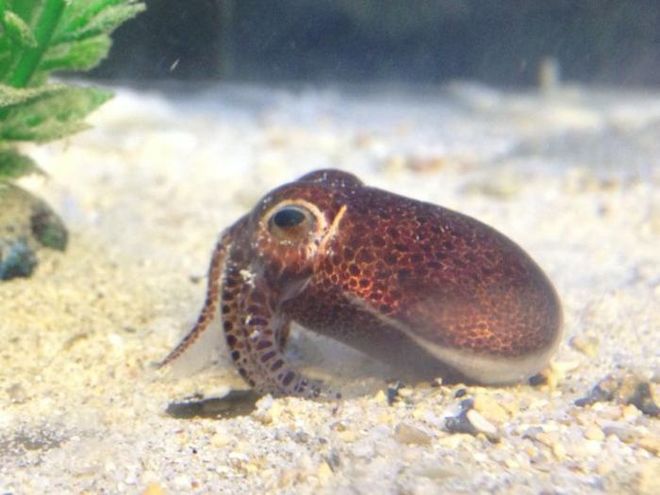
Ryukyuan bobtail squid (Euprymna brenneri)
(Image Credit: Jeff Jolly)
Because both the fossil record and genetic data are incomplete, researchers have struggled to piece together the evolutionary history of squid and cuttlefish, collectively known as decapodiform cephalopods.
Built through a five-year international collaboration, the research combines existing datasets with newly sequenced genomes to fill gaps in the cephalopod family tree.
Squid genomes can be up to twice the size of the human genome, and sequencing them requires fresh biological samples — something that is difficult to obtain from species that live in deep-sea environments or remote tropical reef systems.
The clearer picture points to early squid and cuttlefish likely evolving in the deep ocean, where oxygen-rich pockets may have offered refuge during the Cretaceous–Paleogene (K–Pg) mass extinction around 66 million years ago.
While that event wiped out roughly three-quarters of all species, including non-avian dinosaurs, these early cephalopods appear to have survived by remaining in deeper waters. Near the surface, conditions would have been more hostile, with ocean acidification likely degrading their internal shells.
That deep-sea origin may also explain why many of these animals retained internal shells over time, a feature that would have been harder to maintain in more acidic, shallow environments.
These animals are also surprisingly difficult to compare. While most share an internal shell, its form varies widely — from the rounded cuttlebone of cuttlefish to the thin, blade-like gladius in squid, or even a tightly coiled spiral in species like the ram’s horn squid.
That last species helped resolve another long-standing question. Its unusual shell structure had led some researchers to group it with cuttlefish, but genomic data now places it elsewhere in the evolutionary tree, helping clarify relationships across the group.
A ‘Long Fuse’ Before an Evolutionary Explosion
One of the study’s most interesting findings is how uneven this evolutionary history was. The major squid and cuttlefish lineages first split around 100 million years ago, but then, for tens of millions of years, relatively little changed. Then came a sudden shift.
After the mass extinction, as coral reefs began to recover and expand along coastlines, squid and cuttlefish moved into these newly available shallow-water habitats. That ecological shift appears to have triggered a burst of diversification, as species adapted to new environments.
Researchers describe this pattern as a “long fuse” model: a long period of evolutionary stability followed by a sudden explosion of diversity.
Why It Matters for Understanding Squid Today
With a clearer evolutionary framework in place, researchers can now start linking that history to the traits that make these animals so unusual.
Squid and cuttlefish are known for features rarely seen elsewhere in the animal kingdom, from dynamic camouflage and jet propulsion to complex nervous systems and behavior.
By comparing genomes across species, researchers can begin to identify when and how these traits emerged.
“With these genomes and with a clear picture of their evolutionary relationships, we can make meaningful comparisons to uncover the molecular changes associated with major cephalopod innovations,” said co-author Daniel Rokhsar.
Read More: Once Thought Mythical, Colossal Squid Spotted Alive for the First Time
Article Sources
Our writers at Discovermagazine.com use peer-reviewed studies and high-quality sources for our articles, and our editors review for scientific accuracy and editorial standards. Review the sources used below for this article:
Source: Read Full Article