










It wasn’t supposed to be a breakthrough — just a quiet moment at the end of a long day for paleontologist Rudy Lerosey-Aubril. Under the microscope, something refused to fit. A 500-million-year-old arthropod showed the wrong kind of front limb. Where there should have been a sensory antenna, there was a pincer.
That pincer is known as a chelicera, the defining feature of chelicerates, the group that includes spiders, scorpions, mites, and horseshoe crabs. Unlike antennae, chelicerae grasp or pierce prey and, in some species, deliver venom. No unambiguous chelicera-bearing arthropod had ever been identified from the Cambrian — until now.
That moment led to the description of a new species, Megachelicerax cousteaui, now the oldest known chelicerate. Found in Utah’s Wheeler Formation, the fossil pushes the origin of this group back 20 million years. The findings were published in Nature.
“When I first realized that the frontal appendage […] formed a pincer at its tip, it took me a few minutes to fully grasp that I was looking at the oldest chelicera ever discovered,” Lerosey-Aubril told Discover. “I simply did not expect this in such an ancient arthropod […]. My first feeling was excitement — I immediately understood the significance of this discovery.”
Cambrian Fossil Reveals Earliest Chelicerates
The fossil comes from a deposit that preserves soft-bodied anatomy. Over more than 50 hours of preparation, Lerosey-Aubril exposed a nearly complete body plan.
At just over eight centimeters long, Megachelicerax had limbs at the front for grabbing food and sensing its surroundings, and a segmented body with plate-like structures for breathing, similar to those of modern horseshoe crabs.
This layout shows that key traits of chelicerates, including clawed mouthparts and different body parts handling different tasks, had already taken shape by the mid-Cambrian.
The fossil also shows that the split between chelicera-bearing arthropods and antenna-bearing groups dates back at least half a billion years, marking one of the earliest divisions in animal evolution.
The oldest known chelicerates previously came from the Early Ordovician Fezouata Biota of Morocco, around 480 million years ago. This fossil places their origin earlier than previously confirmed.
“Providing unequivocal evidence for the presence of chelicerates in Cambrian seas changes our perception of early animal evolution,” Lerosey-Aubril shared with Discover.
The species is named after ocean explorer Jacques-Yves Cousteau, reflecting his role in bringing awareness to the beauty and complexity of marine life.
Read More: Animals of the Cambrian Period Experienced a Great Evolutionary Surge, Shaping Life Today
Rewriting Early Animal Evolution
The fossil comes from a time just after the Cambrian Explosion, when many of the structures seen in modern animals took shape over a relatively short window of evolutionary time.
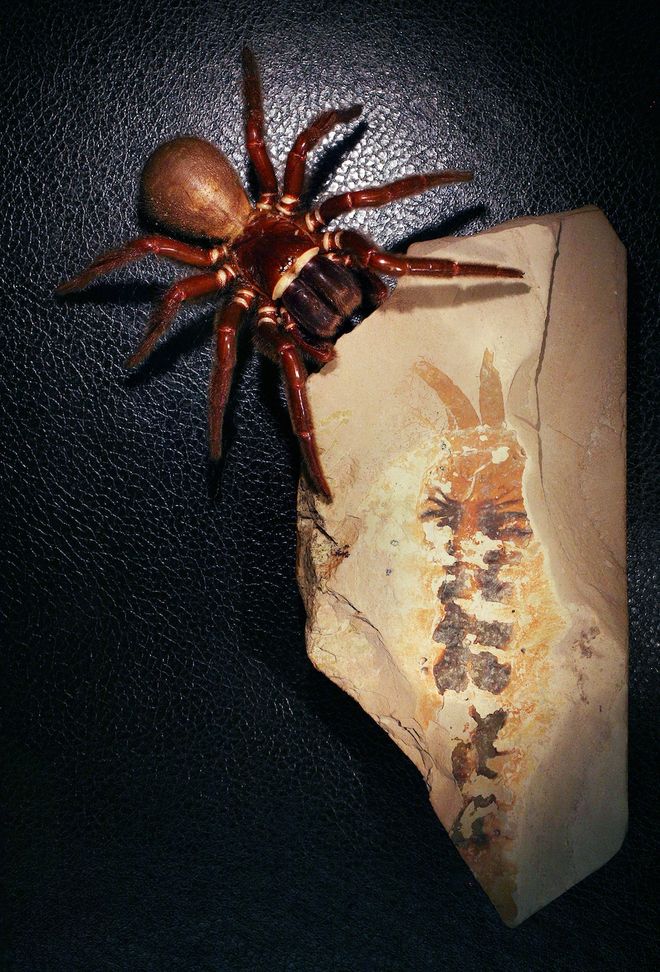
Modern Day Spider with Megachelicerax cousteaui.
(Image Courtesy of Rudy Lerosey-Aubril)
It also highlights a disconnect between form and success. Even with these capabilities, early chelicerates remained a small part of Cambrian ecosystems and lived alongside much simpler organisms for tens of millions of years. Their anatomy only became an advantage later, as some groups moved onto land.
“This pattern highlights the importance of historical context in the emergence of new life forms. In a sense, it mirrors the origin of animals itself, which may have been inconspicuous, likely occurring around 700 million years ago, with these organisms only becoming ecologically dominant in marine environments some 150 million years later,” explained Lerosey-Aubril to Discover.
The discovery shows that when a trait appears, it can matter as much as what that trait is.
Today, chelicerates include more than 120,000 living species, from spiders to horseshoe crabs and sea spiders, found in both land and water. Over time, they have come to shape human life in unexpected ways, with roles in culture, medicine, and agriculture.
Read More: How Index Fossils Help Reconstruct Earth’s Ancient and Mysterious Past
Article Sources
Our writers at Discovermagazine.com use peer-reviewed studies and high-quality sources for our articles, and our editors review for scientific accuracy and editorial standards. Review the sources used below for this article:
Source: Read Full Article