










As we move further and further away from the heydays of the audio CD, things are getting a little muddled. Perhaps it wouldn’t matter so much if physical media like vinyl, CDs, and cassettes were making a niche comeback among certain groups of people.
So I’ve put together some myths, both old and new, that exist around audio CDs. Some are ones I’ve encountered for the first time on social media and forums, and others have been around for a while. Either way, if you believe one or more of these, it’s time for a course correction.
CDs don’t actually have perfect sound forever
Everything rots away eventually
It’s true that, unlike vinyl, which sounds the best the first time you play it and then never sounds that good again, CDs do not wear down from repeated playback. Because the music is digitally represented, it never changes, right?
Well, that is technically true, but CDs can degrade. There’s the issue of disc rot, which is relatively rare but can affect discs that have manufacturing errors or have sustained damage that exposes the metal reflective layer to the atmosphere.
CDs have built-in error-correction, which is pretty robust and will try to play what it can read to the bitter end. You won’t hear quality degradation, but skipping and interpolation can become audible if the damage is too much. This is one big advantage of analog media such as tape or vinyl, because even if those media are degraded, it doesn’t prevent some version of the audio playing.
That said, CDs are very robust. Both my parents and I have CDs from the late ’80s and ’90s that still play perfectly, because they were handled and stored correctly.
Scratches don’t always ruin a CD
More than meets the eye
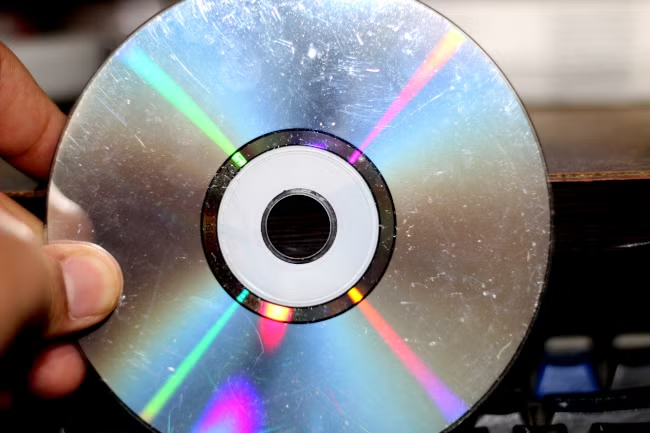
There’s a common perception that if a CD has visible scratches, it’s going to affect playback, and you might as well throw it away. However, remember the error correction I just mentioned? The designers of the audio CD standards have already accounted for this, and early demos of CDs included drilling small holes in CDs and showing that they still play just fine.
One or two scratches are unlikely to do anything to a CD that you can hear, but deep scratches into the data layer or metal coating, or scratches so close together they defeat the limits of the error correction, will cause audible issues or make the disc unplayable. The only way to know is to try the disc. When I buy used CDs, I always check for scratches, and I’ve developed a good eye for what’s probably going to be OK, but nothing stops you from taking a portable CD player with you to test it!
CD players don’t read the surface the way you think
It’s the pits, but also the lands
I myself was under this misconception for a while. Most people think that a CD represents ones and zeros as pits and lands, but that’s a technical inaccuracy. It’s the change from a pit to a land or vice versa that represents a one or a zero. Technology Connections had an excellent deep dive into this, and it starts at 4:35.
This encoding method caused all sorts of engineering challenges, which just gives me more respect for the CD.
The shiny bottom isn’t the most important part of the disc
A literal metal album
So you know that there are physical pits and lands in a factory-pressed CD, but did you know they are in the plastic part of the disc and not the shiny reflective layer? Take a few minutes to watch this awesome segment from the show How It’s Made.
Pretty cool, right? But that highlights why scratches on the label side can be even worse for a CD than those on the “data” side. Sure, the pits and lands are molded into the bottom layer, but without the reflective backing, the laser will just shine through instead of being reflected. So, while a disc may be scratch-free on the bottom, if there’s a scratch in the metal layer from the other side, the laser will read nothing at all in those sections.
Burned CDs aren’t like pressed discs
The dye dies
This is one I encountered pretty recently, where it was clear that some people think writable discs like CD-Rs are exactly the same thing as factory-pressed discs. This is a problem, because they were applying the estimated lifespan of CD-R and other writable optical media to factory discs as an argument against physical media being a form of preservation.
Writable discs do not have a metal reflective layer and molded pits and land the way a factory-pressed CD does. Instead, it has a coating of thermally sensitive dye. The laser activates this dye, which then gives it the optical properties of pits and lands.
However, that dye degrades over time even if you store the disc correctly and handle it with care. It’s not chemically stable and can’t be compared to the sealed aluminum layer and physical pits and lands in a pressed disc at all when it comes to robustness.
CDs are absolutely worth collecting, preserving, and enjoying. They aren’t perfect, and the quality isn’t technically as good as modern “lossless” formats, but give me a shiny CD any day and I’ll be a happy camper.
Source: Read Full Article